
Article At A Glance
- Most people overestimate their preparedness — feeling ready and being ready are two very different things, and an honest self-assessment reveals the gap fast.
- A preparedness review covers six critical areas: food, water, health/medical, finances, bug-out readiness, and communications — skipping even one creates dangerous blind spots.
- Water is the most commonly overlooked gap — most households store far less than the recommended one gallon per person per day, and even fewer have a backup filtration method.
- Your preps have an expiration date — medications, food stores, batteries, and even your own skills and knowledge need to be checked and refreshed regularly.
- Keep reading to find out which preparedness category most families fail first — the answer may surprise you.
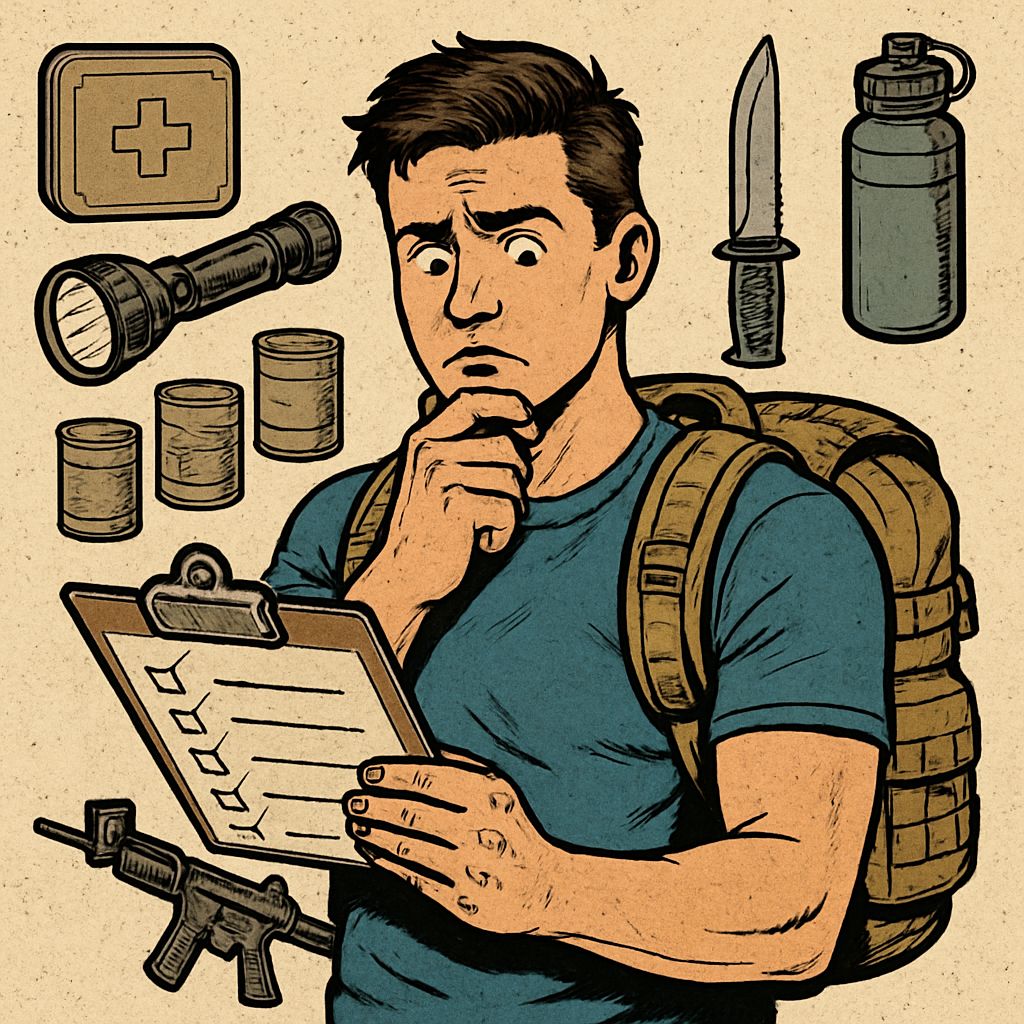
In many cases, people who consider themselves prepared have never actually tested whether their preparation would hold up when it matters most.
People Are Less Prepared Than They Think
There’s a psychological comfort that comes from stacking cans in the pantry or buying a bug-out bag. It feels like preparedness. But feelings aren’t a crisis plan. Real readiness only shows itself under pressure — and by then, it’s too late to patch the holes.
Research and real-world emergency response consistently show that most households dramatically overestimate their ability to handle even moderate disruptions. A three-day power outage. A week-long weather event. A sudden job loss. These aren’t apocalypse scenarios — they’re Tuesday. And yet, many families find themselves scrambling.
The core problem isn’t motivation. Most people who prep want to be ready. The problem is the absence of a structured review process that forces honesty about what’s actually working.
The Gap Between Feeling Prepared and Actually Being Prepared
Feeling prepared is passive. Actually being prepared is active, documented, and tested. The gap between the two usually shows up in small but critical failures: the flashlight with dead batteries, the water supply that runs out on day two, the medication that expired six months ago. These aren’t catastrophic oversights — they’re normal — but they compound quickly when layered together during a real emergency.
The goal of a preparedness progress review isn’t to make you feel bad about your preps. It’s to surface those small failures before a crisis does. Think of it like a home inspection before a storm. You want to find the weak points when you still have time to fix them.
Why an Annual Preparedness Review Changes Everything
Preparedness isn’t a one-time event. It’s a practice. Families grow, medical needs change, shelf lives expire, and new risks emerge. An annual review — ideally done at the same time each year so it becomes a habit — gives you a repeatable framework for staying genuinely current rather than just feeling ready.
Beyond the practical benefits, a yearly review builds something equally valuable: confidence. Knowing that you’ve checked your water stores, rotated your food supply, confirmed your evacuation routes, and verified your communication plan creates a different kind of calm when things go sideways.
How to Conduct Your Preparedness Progress Review
The review process doesn’t have to be complicated, but it does have to be honest. Block out a few hours, grab something to take notes with, and commit to answering each question without rationalizing. The point is clarity, not a passing grade.
Step 1: Pull Out Your Calendar and Recall Every Crisis You Faced This Year
Start by looking backward. Go month by month through the past twelve months and identify every disruption your household faced — power outages, illness, job stress, extreme weather, supply chain shortages, anything that forced you to lean on your preps or wish you had them. You’ll likely remember more than you expect.
Write each event down. Next to each one, note whether you were prepared, partially prepared, or caught off guard. This isn’t about blame — it’s raw data. Those moments where you found yourself scrambling are exactly where your review needs to focus. For insights on how to introduce a culture of preparedness at home, check out this guide on preparedness culture.
Don’t limit yourself to dramatic events. A three-day illness that wiped out your household’s ability to cook meals, or a week where your budget was too tight for groceries, counts just as much as a hurricane. Minor emergencies reveal just as many gaps as major ones. Consider exploring budget-friendly preparedness purchases to help fill these gaps.
Step 2: Identify Where Your Preps Held Up and Where They Failed
Now that you have your list of events, map your preps against them. For each disruption, ask: What resources did I use? What did I wish I had? What ran out faster than expected? This two-column exercise — what worked vs. what didn’t — becomes the foundation of your entire action plan.
Pay close attention to the near-misses. These are the events where your preps almost weren’t enough. Near-misses are more instructive than outright failures because they tell you exactly how close to the edge your current level of readiness actually sits.
Step 3: Score Each Category Honestly
Use a simple 1–5 scale to rate your household’s readiness across the six core categories: food storage, water, health and medical, financial preparedness, bug-out and evacuation readiness, and communications. A score of 1 means essentially no preparedness in that area. A 5 means you’ve tested it, it held up, and it’s current. Most households will find they’re a 3 or 4 in one or two categories and a 1 or 2 in at least one area they’ve been avoiding.
Food Storage: Did Your Pantry Actually Feed You?
Food storage is where most people begin their preparedness journey, and often where they stop. A full pantry is comforting, but the real question is whether that food would actually sustain your household through a meaningful disruption — not just a missed grocery run.
The standard recommendation is a minimum 72-hour supply, but experienced preppers and emergency management professionals consistently recommend building toward 30 days or more. The gap between where most households are and where they need to be is usually significant.
Did You Run Out of Any Critical Items This Year?
Think back to any moment this year when you reached for something and it wasn’t there — medications, specific foods for dietary restrictions, infant supplies, pet food. Any item you ran out of during a stressful period is an item that belongs on your priority restocking list, full stop. It’s also essential to have essential medical skills to manage emergencies when supplies are low.
Off-Grid Cooking: Could You Prepare Food Without Power or Gas?
Storing food and being able to cook food are two different things. If your entire pantry consists of items that require a functioning stove or microwave, a power outage immediately cuts your food security in half. Your review should confirm that you have at least one tested off-grid cooking method — a propane camp stove, a wood-burning rocket stove, or a solar oven — and that you know how to use it safely.
Garden Success or Failure: What the Results Tell You
If you grew any food this year, your garden results are a direct preparedness data point. What produced well? What failed? Did you preserve or store any of what you grew? A garden that produces but isn’t preserved adds zero to your long-term food security. If gardening is part of your preparedness plan, your review should assess not just what you grew, but what you were actually able to put away.
Even a small container garden that produced herbs, tomatoes, or greens tells you something important: your household has a supplemental food skill that doesn’t depend on supply chains.
Water Preparedness: The Most Overlooked Gap
Water is where preparedness plans most frequently fail — and most quietly. It rarely gets the attention that food storage does, even though a human being can survive weeks without food and only days without water.
The standard guidance from FEMA and the Red Cross is one gallon per person per day for drinking and basic sanitation. For a family of four over a 30-day disruption, that’s 120 gallons. Most households that have “water storage” have a few cases of bottled water — which covers perhaps three to five days at best, and often less when accounting for cooking, hygiene, and pets.
During your review, physically count what you have stored right now. Not what you think you have — what you can actually put your hands on today. Count every sealed water container, every WaterBOB emergency bathtub bladder, every five-gallon jug. Then compare that number against the table above. The difference between those two numbers is your water gap, and it’s the first thing worth addressing after this review.
Keep in mind that the one-gallon-per-day figure is a baseline, not a comfortable number. It covers drinking and minimal sanitation. Add pets, a nursing mother, anyone doing physical labor, or anyone in a hot climate, and that number climbs fast. A realistic target for most households is closer to 1.5 to 2 gallons per person per day once real-world conditions are factored in.
Water storage doesn’t have to mean a warehouse full of jugs. A single 55-gallon Blue Barrel BPA-free water drum stored in a cool, dark space covers one person for nearly two months on the baseline figure — and costs less than $100 fully outfitted with a hand pump and bung wrench. That’s one of the highest-value preparedness investments available at any budget level.
Filtration and Purification: Do You Have a Backup If Tap Water Fails?
Stored water handles the short term. A filtration system handles everything beyond it. Your review should confirm that you have at least one reliable method to filter and purify water from an alternative source — a river, a lake, a rain collection barrel, or a community source. The Sawyer Squeeze Filter removes 99.9% of bacteria and 99.9% of protozoa, weighs under three ounces, and filters up to 100,000 gallons before replacement. The Berkey Big Berkey countertop gravity filter is a strong option for household use, capable of filtering up to 6,000 gallons per set of Black Berkey elements. Having both a portable and a stationary option gives your household real redundancy.
Purification tablets — specifically Potable Aqua Iodine Tablets or Aquatabs chlorine dioxide tablets — are a low-cost, zero-maintenance backup that every kit should include. They won’t replace a quality filter, but they weigh almost nothing and can be a lifesaver when everything else fails. Check your supply during your review and replace any that have passed their expiration date.
Health and Medical Readiness
Medical preparedness is the category most people acknowledge they need to improve and then consistently push to next year. A crisis doesn’t wait for next year. Your review needs to take an honest look at prescription supplies, first aid capability, and the physical and emotional readiness of every person in your household.
Were You Caught Without Medicine or Supplies You Thought You Had?
Go through your medicine cabinet and first aid supplies right now — not later, now. Check every prescription medication and confirm you have at least a 30-day buffer supply. Check expiration dates on over-the-counter medications, wound care supplies, and any specialty items your household depends on, like EpiPens, insulin, or blood pressure medication. An EpiPen, for example, expires 12 to 18 months after manufacture, and an expired one during an anaphylactic reaction is a life-threatening problem.
Beyond prescriptions, your kit should include the basics that most people assume they have but frequently don’t: a tourniquet (the CAT Gen 7 Combat Application Tourniquet is the gold standard), hemostatic gauze like QuikClot, a blood pressure cuff, oral rehydration salts, and a 7-day supply of common medications like antihistamines, antidiarrheals, and pain relievers. If your first aid kit is a store-bought plastic box that hasn’t been opened since you bought it, that’s your starting point.
First Aid Skills: Knowledge Expires Too
Gear without training is just expensive clutter. When did you last take a first aid or CPR certification course? The American Red Cross recommends recertification every two years for CPR, and hands-on skills genuinely degrade without practice. Your review should include an honest answer to this question: if someone in your household had a medical emergency right now, could you handle it effectively until professional help arrived — or if professional help never came? To ensure you’re prepared, consider learning essential medical skills that everyone should know.
Mental and Emotional Preparedness for Everyone in Your Home
Physical supplies get most of the attention, but mental and emotional resilience is what determines whether a family actually functions during a prolonged crisis. Stress, fear, uncertainty, and disrupted routines hit children especially hard. Your review should ask whether your household has talked openly about emergency scenarios, whether your kids know what to do if something happens, and whether you’ve identified anyone in your household who may need additional emotional support during a crisis.
Small investments here pay large dividends. Keeping a few familiar comfort items in your emergency kit — a favorite book, a card game, a small toy — can make an enormous difference in how children cope with displacement or disruption. For adults, having a clearly defined role and a practiced plan dramatically reduces panic response. Preparedness is as much a psychological practice as a physical one.
Financial Preparedness Most Preppers Skip
Financial readiness rarely shows up in preparedness checklists, but it’s one of the most common reasons families can’t maintain or build their preps in the first place. A job loss, a major medical bill, or an economic disruption can wipe out years of physical preparedness if there’s no financial buffer underneath it.
Cash on Hand When Digital Payments Fail
When the power grid goes down, so do card readers, ATMs, and digital payment systems. Cash becomes the only transactional currency that works. Your review should confirm that you have a meaningful amount of physical cash stored securely at home — financial advisors and preparedness experts generally recommend a minimum of $500 in small bills, with $1,000 or more for households with dependents. Small denominations matter because making change becomes difficult and people are less likely to accept large bills when systems are down. For more insights on introducing a preparedness culture at home, check out this guide on family preparedness.
Emergency Fund vs. Preparedness Budget: Why You Need Both
These are two separate financial tools that serve different functions, and conflating them is a common mistake. An emergency fund is liquid savings — typically three to six months of living expenses — that cushions against income disruption. A preparedness budget is the recurring monthly allocation you use to build and maintain your physical preps. For guidance on budget-friendly preparedness purchases, neither one replaces the other.
- Emergency fund goal: 3 to 6 months of household expenses in a high-yield savings account
- Monthly preparedness budget: Even $25 to $50 per month, consistently applied, builds substantial supplies over 12 months
- Cash on hand: Minimum $500 in mixed small bills stored securely at home
- Insurance review: Annual check of home, health, auto, and life coverage to confirm it reflects current needs
- Debt exposure: High consumer debt reduces your flexibility to respond to financial emergencies — it belongs in your preparedness picture
During your review, look at both. Do you have an emergency fund? Is it funded to the level it needs to be? And separately — did you have a preparedness budget this year, and did you stick to it? If the answer to either question is no, those become action items before anything else.
Financial preparedness also means knowing where your important documents are and having copies accessible. Birth certificates, insurance policies, property deeds, medical records, and identification documents should be stored in a fireproof document safe like the SentrySafe SFW123GDC and backed up digitally in an encrypted cloud storage account. Losing these documents during a disaster creates a secondary crisis that can take months to resolve.
Bug Out and Evacuation Readiness
Most preparedness planning is built around sheltering in place — and that’s smart, because staying home is almost always the better option when it’s safe to do so. But some situations demand you leave, and fast. Wildfires, flooding, chemical spills, and civil unrest can all create scenarios where staying puts you at greater risk than going.
Evacuation readiness isn’t just about having a bag packed. It’s about having a plan that every member of your household knows, has practiced, and can execute without you present. That last part — without you present — is where most evacuation plans break down completely.
Your review should assess three things: whether your bug-out bags are current and complete, whether your evacuation routes are identified and have alternates, and whether every person in your household — including children — can articulate what to do and where to go if they need to leave quickly.
Does Your Bug Out Bag Still Have Everything It Should?
Open your bug-out bag during this review. Don’t just look at it — open it and go through it item by item. Food bars expire. Water pouches can develop micro-leaks. Batteries drain. Medications pass their expiration date. The 5.11 TacticalRush 72 Backpack is a popular platform, but the bag itself is only as useful as what’s inside it and whether that contents list is current. A bug-out bag that hasn’t been audited in 18 months is a bag full of assumptions.
Your bag should cover 72 hours of independent survival for one person and include: water and filtration, at least 2,000 calories per day in shelf-stable food, a first aid kit, a multi-tool, fire-starting equipment, a hand-crank or solar emergency radio like the Midland ER310, copies of critical documents, cash, a change of weather-appropriate clothing, and any prescription medications. If any of those categories are missing or depleted, they go directly onto your action list.
Does Every Person in Your Household Know the Evacuation Plan?
Ask each person in your household — right now, without warning — where they would go if they had to leave home in 15 minutes. Could they answer? Do they know the primary and secondary meeting points? Do they know the out-of-area contact person that everyone would check in with if local communications were disrupted? If the answers are uncertain or inconsistent, your evacuation plan exists on paper only, not in practice.
Children as young as five or six can learn and retain a simple evacuation plan when it’s been practiced. Running a low-stress family evacuation drill twice a year — treating it more like a fire drill than a crisis — builds the kind of muscle memory that holds up under real pressure. The goal isn’t to frighten anyone. It’s to make the right response feel automatic.
Communication and Information Readiness
When a crisis hits, the first thing most people reach for is their phone — and the first thing that fails is cell service. Communication infrastructure is fragile, and it’s one of the fastest systems to become overwhelmed or go dark during a regional emergency. Your preparedness review needs to honestly assess how your household would send and receive critical information if your phone, internet, and local broadcast systems all failed simultaneously.
A hand-crank or battery-powered NOAA weather radio like the Midland ER310 or the Kaito KA500 gives you access to emergency broadcasts without depending on cell towers or internet connectivity. This is a non-negotiable baseline. Beyond that, consider whether your household has a designated out-of-area contact that every member knows to call or text — someone outside your region who can serve as a communication hub when local lines are jammed. Text messages often get through when voice calls can’t, so make sure everyone in your household knows to text first during a major emergency.
For households that want deeper communication capability, a Family Radio Service (FRS) radio or a GMRS radio like the Midland GXT1000VP4 allows direct household-to-household communication without any infrastructure. If anyone in your household holds or is willing to obtain an amateur radio license, a handheld ham radio like the Baofeng UV-5R dramatically expands your communication range and access to emergency nets. Check your communication tools during this review: test the batteries, confirm everyone knows how to operate them, and make sure your out-of-area contact plan is documented somewhere other than your phone.
Turn Your Review Into a Concrete Action Plan
A review that ends with a list of gaps and no next steps is just a worry session. The entire value of this process comes from what you do with the information it surfaces. Every weakness you identified during your assessment needs to become a dated, specific action item — not a vague intention, but a real commitment with a deadline attached to it.
How to Prioritize Your Weakest Areas First
Look at your category scores from Step 3 of the review. Any category you scored a 1 or 2 is your starting point, regardless of how uncomfortable or expensive it feels to address. Prioritizing the areas where you’re most exposed — not the areas that are easiest or most interesting to work on — is what separates genuine preparedness from the illusion of it.
Use a simple triage system. Rank your gaps by two factors: how likely that gap is to be exposed in a real emergency, and how severe the consequences would be if it were. Water filtration, prescription medication supply, and evacuation plan knowledge consistently score high on both factors for most households. Address those first, then work down the list. Avoid the temptation to start with gear purchases when the real gap is skills or planning.
Set Monthly Preparedness Milestones That Actually Get Done
Break your action list into monthly milestones rather than one overwhelming project. Assign one to three specific tasks per month — rotate the food storage, purchase a water drum, schedule a family evacuation drill, take a first aid refresher course — and calendar them like appointments. Preparedness goals that aren’t scheduled are preparedness goals that don’t happen. A modest and consistent $25 to $50 per month applied to your weakest areas will compound into meaningful readiness over 12 months faster than most people expect.
When to Repeat This Review Throughout the Year
The full annual review is your foundation, but a lighter quarterly check-in keeps your preps current between full assessments. Set a reminder every three months to do a 30-minute scan: check expiration dates, confirm cash on hand, verify that everyone still knows the evacuation plan, and rotate any food or water that’s approaching its shelf life. Big changes in your household — a new baby, a moved family member, a new medical diagnosis, a change in living situation — should trigger an immediate partial review regardless of where you are in the calendar year.
Preparedness Review Schedule at a Glance
Annual (Full Review): All six categories, scored and documented. Schedule for the same time each year — January 1st, a birthday, or a seasonal marker works well as a recurring anchor.
Quarterly (Light Check-In): Expiration dates, cash supply, evacuation plan confirmation, communication gear test. Takes 30 minutes or less.
After Any Household Change: New family member, medical change, relocation, or major life event triggers an immediate partial review of affected categories.
After Any Emergency Event: Any time you actually use your preps — even partially — conduct a rapid after-action review. What worked? What ran out? What did you wish you had?
The seasonal approach works well for many families because it ties preparedness tasks to natural behavioral shifts. Spring is a good time to review storm and flood readiness. Summer is the right moment to check wildfire evacuation plans and vehicle kits. Fall maps naturally to food storage rotation and heating backup systems. Winter is ideal for the full annual review, financial assessment, and medical supply audit.
Doing your review at a consistent, anchored time each year removes the decision fatigue of figuring out when to do it. It becomes a habit rather than a task — and habits are what actually sustain long-term preparedness. The families who are genuinely ready in year five aren’t the ones who bought the most gear in year one. They’re the ones who kept showing up, reviewing, adjusting, and improving their preparedness culture.
Document everything. Keep a simple preparedness journal — even a basic notebook — where you record your scores, your gaps, your action items, and your progress. Over time, this document becomes an invaluable record of how your household’s readiness has evolved, what you’ve learned from real emergencies, and what still needs work. It also makes next year’s review significantly faster because you’re building on a documented foundation rather than starting from memory.
A Prepared Family Is Built One Review at a Time
No household goes from unprepared to fully ready in a single weekend. Real preparedness is built incrementally, through consistent effort, honest evaluation, and the willingness to look at your gaps without flinching. Every review you complete — even the ones that surface uncomfortable truths — makes your household measurably more capable of handling whatever comes next.
The families who weather crises well are rarely the ones with the biggest stockpiles. They’re the ones who know their plan, have practiced it, and have built the kind of layered readiness that holds up under real-world conditions. That kind of readiness doesn’t come from a single purchase or a single checklist. It comes from a commitment to regular, honest self-assessment and steady, intentional improvement.
Start where you are. Use what you learned in this review. Pick the highest-priority gap and take one concrete step toward closing it this week — not someday, this week. Preparedness isn’t about being perfect. It’s about being more ready today than you were yesterday, and more ready next year than you are right now.
Frequently Asked Questions
Below are the most common questions people have when starting or repeating their preparedness progress review.
How Long Does a Preparedness Progress Review Take?
A full annual review, done thoroughly, typically takes two to four hours for most households. That includes going through each of the six categories, physically checking supplies, scoring your readiness levels, and building an initial action list. It’s worth blocking out a dedicated morning or afternoon rather than trying to fit it into a busy day.
The quarterly check-in is much lighter — most households can complete it in 30 minutes or less. The investment of time is minimal compared to the cost of discovering a critical gap during an actual emergency.
What Is the Most Common Preparedness Gap Families Overlook?
Water preparedness is consistently the most overlooked category across households at every level of preparedness experience. Most families significantly underestimate how much water they actually need and have no backup filtration method if tap water becomes unavailable. It’s also one of the least expensive gaps to close, which makes the oversight even more avoidable.
Should I Involve My Kids in the Preparedness Review?
Yes — age-appropriately and without creating fear. Children who understand basic emergency procedures and know the family plan are a genuine asset during a crisis rather than an additional stress point. Walk older kids through the evacuation plan, show younger children where supplies are kept, and frame the conversation around taking care of each other rather than focusing on frightening scenarios. Preparedness becomes part of their normal frame of reference, which is exactly what you want.
How Do I Prepare for Emergencies When I’m on a Tight Budget?
Focus on the highest-impact, lowest-cost improvements first. A case of water, a bag of rice, a bag of lentils, a box of iodine tablets, and a hand-crank radio can be purchased for well under $50 and represent a meaningful baseline. Build incrementally — even $10 to $20 per month consistently applied over a year produces substantial results.
How Do I Know If My Food Storage Supply Is Actually Enough?
Calculate your household’s daily caloric needs — typically 2,000 calories per adult per day as a baseline — and multiply by the number of days you want to cover. A 30-day supply for two adults requires approximately 120,000 calories of shelf-stable food. Count what you actually have, not what you think you have, and compare it against that number.
Also consider dietary variety, nutritional balance, and special needs. A supply of nothing but white rice technically covers caloric needs but creates serious nutritional deficiencies over 30 days. Aim for a balance of proteins, fats, carbohydrates, and calorie-dense foods — canned meats, legumes, whole grains, nuts, and freeze-dried vegetables — that would genuinely sustain your household’s health, not just prevent starvation.
Preparedness is not just about having supplies on hand; it’s about knowing how to use them effectively in a crisis. Regularly evaluating your readiness can make a significant difference in how well you cope with unexpected events.




Leave a Reply