
Article At A Glance
- Martial arts trains your whole self — not just your body, but your mind, emotions, and character in ways most people never expect when they first step on the mat.
- The mental and emotional benefits are just as powerful as the physical ones — from stress relief and emotional regulation to resilience and self-confidence that carries into every part of your life.
- You don’t need to be fit, young, or athletic to start — complete beginners see real, measurable benefits within weeks of consistent training.
- One specific martial art stands out as the best starting point for self-confidence — and the answer might surprise you.
- Martial arts is a powerful tool for personal growth, but it has real limits — especially when it comes to mental health treatment, which is something every practitioner should understand.
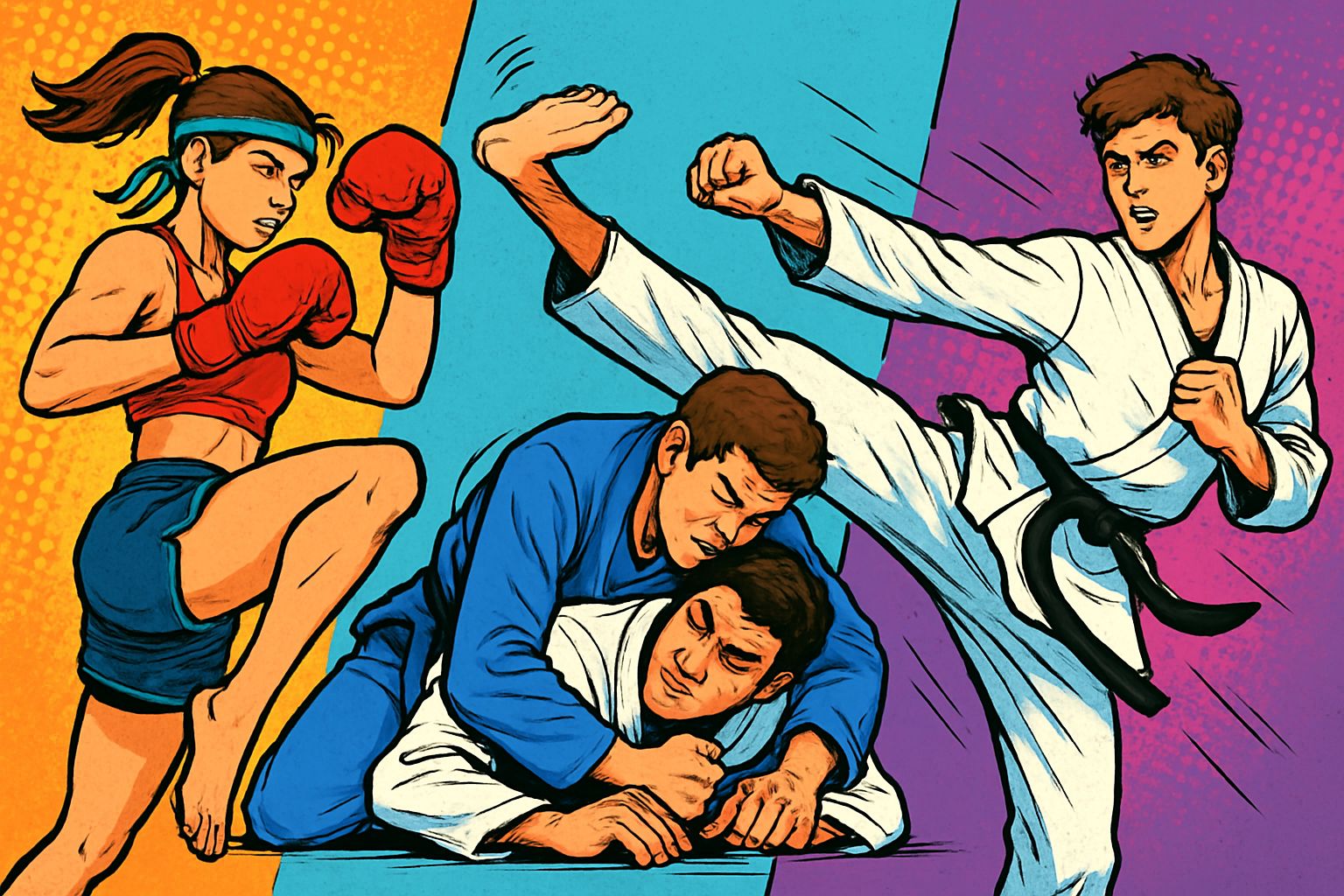
People walk into their first martial arts class expecting to learn how to throw a punch — and they walk out having started one of the most transformative journeys of their lives.
Whether you’re drawn to the explosive striking of Muay Thai, the chess-like ground game of Brazilian Jiu-Jitsu, or the fluid philosophy behind Aikido, every martial art shares a common thread: they all demand that you show up fully — physically, mentally, and emotionally. That demand is exactly what makes them so powerful for personal growth. For self-improvement enthusiasts looking to explore this further, resources like those found through dedicated martial arts and wellness communities can be a strong starting point.
Martial Arts Is More Than Fighting
Strip away the belts, the tournaments, and the flashy highlight reels, and what you’re left with is a system for developing human beings. Every technique, every drill, every sparring round is designed to expose your weaknesses — not to humiliate you, but to give you something real to work on. That’s a rare thing in modern life.
The American Journal of Men’s Health published research exploring how integrated martial arts training combined with structured personal development produced measurable improvements in young men’s mental health. That kind of evidence only confirms what practitioners have known for centuries: the mat is one of the most honest mirrors you will ever stand in front of.
Physical Benefits That Go Beyond the Gym
A standard martial arts session works muscle groups that most gym routines completely ignore. You’re rotating, stabilizing, exploding, absorbing, and recovering — all in the same hour. It’s functional fitness in the truest sense.
Full-Body Conditioning Through Every Session
Unlike isolated weight training, martial arts forces your entire body to work as a single coordinated unit. A Muay Thai round alone engages your legs for footwork and kicks, your core for rotation and balance, your arms for striking and defense, and your cardiovascular system to sustain the effort. There is no “leg day” or “arm day” — every session is a full-body session by default.
After just a few weeks of consistent training, most beginners notice improvements in their posture, grip strength, and overall body awareness. These aren’t minor cosmetic changes — they’re structural improvements that reduce injury risk and improve daily function.
Improved Coordination, Balance, and Reflexes
Martial arts is essentially a coordination laboratory. Every technique requires precise timing between your eyes, your brain, and your body — and that connection gets stronger every time you train.
Balance improves rapidly because almost every stance, kick, and takedown defense requires you to maintain your center of gravity under pressure. Reflexes sharpen because sparring is essentially a live-fire reflex training environment — you can’t think your way through a jab combination, you have to feel and react.
Proprioception — your body’s internal sense of its position in space — also improves significantly with regular training. This is especially valuable as people age, since proprioception naturally declines and is one of the leading contributors to falls and injuries in older adults. To further enhance your understanding, explore how to become harder to disrupt in everyday life.
Cardiovascular Health and Endurance Gains
Three two-minute rounds of sparring will humble any runner who walks in thinking cardio is cardio. Martial arts combines aerobic and anaerobic conditioning in a way that very few other activities can match.
The stop-start intensity of pad work, drilling, and sparring mirrors high-intensity interval training (HIIT), which research consistently links to improved heart health, better oxygen efficiency, and faster metabolic rate. You’re essentially doing HIIT — but it doesn’t feel like a workout because you’re too focused on not getting hit. This type of training can also be a valuable part of emergency readiness, preparing you for unexpected physical challenges.
Over time, your resting heart rate drops, your recovery between rounds shortens, and your overall stamina in daily life improves noticeably. Climbing stairs, carrying groceries, keeping up with your kids — it all gets easier.
Mental Benefits of Martial Arts Training
This is where martial arts separates itself from virtually every other physical activity. The mental benefits aren’t a side effect — they’re baked into the practice itself. You cannot train martial arts passively. The moment your attention drifts, you get reminded very quickly to bring it back.
Dr. Smitha Bhandari, MD, highlights that regular practice encourages emotional stability, assertiveness, self-confidence, and a reduction in aggressive tendencies — not an increase in them, as many outsiders assume.
Key Mental Benefits Documented by Contemporary Psychotherapy Research:
- Reduced symptoms of anxiety through structured breathing and movement
- Improved emotional regulation through repeated exposure to controlled stress
- Greater sense of personal agency and life purpose
- Enhanced focus and present-moment awareness
- Stronger psychological resilience through facing and overcoming physical challenges
What makes martial arts uniquely effective for mental health is the combination of physical exertion, breathwork, social connection, and goal-setting — all happening simultaneously in every class.
Stress Relief Through Breathwork and Mindfulness
Deep, controlled breathing is not optional in martial arts — it’s survival. In Muay Thai, you exhale sharply with every strike. In Jiu-Jitsu, staying calm and breathing through a bad position is often the difference between escaping and tapping out. That practice of breathing under pressure directly transfers to how you handle stress outside the gym.
How Martial Arts Builds Mental Resilience
Every time you show up on a bad day, push through exhaustion, or tap out and get back up, you’re building a psychological database of evidence that you can handle hard things. That evidence compounds over time into genuine mental toughness — the kind that holds up in real life, not just in motivational quotes.
Staying Calm Under Pressure
Sparring is a controlled pressure cooker. When someone is throwing punches at your face — even light, controlled ones — your nervous system fires a stress response. Learning to stay technical, breathe, and make good decisions inside that response is one of the most transferable mental skills martial arts develops. Boardroom presentation, difficult conversation, personal crisis — the same nervous system management applies.
Emotional Growth You Did Not Expect
Nobody tells you that you’re going to cry in the car after a particularly rough sparring session — or that you’ll feel a kind of quiet pride after finally landing a technique you’ve been drilling for three months. Martial arts gets emotional, and that’s not a bug, it’s a feature.
The practice has a way of surfacing feelings and patterns you’ve been carrying around for years. Feelings of powerlessness, fear of failure, difficulty accepting help — the mat has a way of making all of it visible, and then giving you a structured environment to work through it.
“Martial arts can help people establish boundaries by redirecting feelings of powerlessness. It can empower you to find inner strength and heal past trauma.” — WebMD
This is not therapy — and we’ll address the important distinction between martial arts as a personal growth tool and professional mental health treatment later in this article. But for many people, the emotional breakthroughs they experience on the mat are among the most significant of their lives. For those interested in integrating this practice at home, here’s how to introduce preparedness culture in your family setting.
Greater emotional stability emerges naturally when you repeatedly practice staying composed under physical and psychological pressure. You stop reacting to life’s minor frustrations with the same intensity because you’ve trained your nervous system to distinguish between real threats and perceived ones.
Greater Emotional Stability and Self-Control
Emotional self-control is not something you’re born with — it’s a skill, and like every skill on the mat, it gets better with deliberate practice. When you’re drilling techniques under fatigue, sparring with a training partner who’s better than you, or sitting with the discomfort of being a white belt in a room full of colored belts, you’re repeatedly practicing the art of not reacting impulsively. That practice bleeds into your everyday life faster than you’d expect.
Over time, practitioners consistently report that small frustrations — traffic, difficult coworkers, minor setbacks — simply stop triggering the same emotional charge they once did. Your baseline shifts. What used to feel overwhelming starts to feel manageable, because you’ve already trained your nervous system to stay composed under far more intense pressure than a bad commute.
How Martial Arts Helps Heal Past Trauma
This is one of the most profound and least talked-about benefits of consistent martial arts training. For people who have experienced powerlessness — through abuse, neglect, or other forms of trauma — reclaiming a sense of physical agency can be deeply healing. The act of learning to protect yourself, to move with confidence, and to trust your own body again is transformative in a way that’s difficult to put into words.
Research published in Contemporary Psychotherapy under the topic of martial arts and mental health has explored how structured martial arts training contributes positively to psychological wellbeing. The combination of physical empowerment, structured routine, community support, and breathing practice creates conditions that support genuine emotional healing.
- Redirecting feelings of powerlessness into physical skill-building
- Rebuilding trust in your own body and its capabilities
- Establishing healthy personal boundaries through assertiveness training
- Processing difficult emotions through physical exertion in a safe environment
- Developing a consistent routine that provides structure and stability
The dojo or gym environment also plays a significant role here. A good martial arts school operates on mutual respect — between instructor and student, and between training partners. That culture of respect can be genuinely reparative for people who haven’t experienced it consistently in other areas of their lives.
It’s worth noting that healing through martial arts is a gradual, nonlinear process. There will be sessions that feel like breakthroughs and sessions that feel like you’ve gone backwards. Both are part of the process, and both are valuable.
Self-Confidence That Carries Into Every Area of Life
The confidence martial arts builds is not the loud, performative kind — it’s the quiet, settled kind that comes from knowing exactly what you’re capable of. You’ve been tested, repeatedly, under real pressure, and you came through it. That knowledge doesn’t leave you when you walk off the mat.
What makes this confidence different from the kind you might get from reading a self-help book or attending a motivational seminar is that it’s evidence-based. You didn’t just hear that you were capable — you proved it, to yourself, in real time, with your body. That’s a fundamentally different kind of knowing, and it sticks. For more insights on the benefits of martial arts, check out this WebMD article.
How Mastering Skills Rewires Your Self-Image
Every new technique you learn, every belt you earn, and every challenge you survive sends a message to your brain: I can learn hard things. That message accumulates into a completely different self-image over months and years of training.
- White belt — you learn that starting is enough, and that looking foolish is survivable
- Early progress — you discover that consistent effort produces real results
- First sparring session — you learn that fear doesn’t have to stop you
- First stripe or belt promotion — you internalize that growth is measurable and real
- Teaching a newer student — you realize how far you’ve actually come
Each of these milestones rewires a small part of how you see yourself. Most people who train for a year or more describe a fundamental shift in their identity — not just “I do martial arts” but “I am someone who does hard things.”
That identity shift is perhaps the most valuable long-term outcome of martial arts training. Identity shapes behavior. When you see yourself as disciplined, resilient, and capable, you make choices that align with that self-image — in your career, your relationships, and your health.
WebMD’s review of martial arts benefits specifically highlights increased self-esteem as one of the core psychological outcomes, noting that the process of bouncing back from setbacks in training directly builds the mental muscle needed to become harder to disrupt in everyday life.
Facing Setbacks and Learning to Bounce Back
You will get tapped out. You will have sessions where nothing works, where someone half your size makes you look completely lost, and where you drive home questioning why you started. These moments are not obstacles to your development — they are the development. The mat has a zero-tolerance policy for ego, and that’s exactly what makes it such an effective teacher.
The resilience you build through repeated exposure to failure and recovery in a controlled environment is directly transferable to the unpredictability of real life. Job losses, relationship breakdowns, health challenges — the same muscle you use to get off the mat and go again is the one you’ll reach for when life hits hardest.
Finding Your Place and Purpose
Many practitioners describe a deepening sense of life purpose that emerges from long-term martial arts training — a clarity about who they are, what they value, and how they want to move through the world. The discipline, respect, and community that come with serious training have a way of organizing a person’s priorities in ways that are hard to manufacture anywhere else.
The Social Side of Martial Arts
Walk into any legitimate martial arts gym and you’ll immediately notice something different about the social dynamic. People are sweating together, helping each other, laughing, and pushing each other — all at the same time. The shared vulnerability of learning something difficult in front of other people creates a bond that forms faster and runs deeper than most other social environments.
The Academy of Martial Arts notes that choosing the right dojo is one of the most important decisions a new practitioner can make — not just for the quality of instruction, but for the community culture. A gym with a toxic, ego-driven culture will undermine almost every benefit discussed in this article. A gym built on genuine mutual respect will amplify all of them.
Building Real Friendships on the Mats
There’s a specific kind of trust that develops between sparring partners and training partners that’s genuinely rare in adult life. You are literally placing your safety in someone else’s hands — and they’re doing the same with you. That mutual vulnerability, repeated over hundreds of training sessions, builds friendships that often last decades.
For adults who find it increasingly difficult to make genuine friends outside of structured social environments, a martial arts gym can be one of the most reliable places to build real community. The shared struggle is the social glue, and it works remarkably well across age, background, and experience level. Additionally, the discipline learned in martial arts can enhance self-discipline and foster personal growth.
Discipline and Respect as a Way of Life
Martial arts doesn’t just teach you techniques — it teaches you how to show up. Bowing when you enter and leave the mat, addressing instructors with respect, taking care of your training partners, arriving on time, maintaining your gear — these are not arbitrary rituals. They are daily practice in the habits that make a person genuinely trustworthy and reliable.
- Punctuality becomes a habit when your instructor notices who walks in late
- Cleanliness and personal care become non-negotiable when you’re training in close contact with others
- Respect for authority figures deepens when you experience firsthand how much a great instructor genuinely cares about your growth
- Humility becomes a survival strategy when ego consistently gets you submitted
These aren’t lessons you’re told — they’re lessons you live, session after session, until they become part of who you are. The discipline cultivated on the mat has a way of expanding outward into work ethic, relationship quality, and personal standards in every area of life.
Children who train martial arts show particularly strong results in this area. Multiple studies have pointed to improvements in school performance, social behavior, and emotional regulation among young practitioners — and much of that improvement traces directly back to the discipline and respect structures embedded in martial arts culture.
Martial Arts Is Not a Replacement for Mental Health Treatment
This point matters, and it deserves to be stated clearly. Martial arts is a powerful, evidence-supported tool for improving mental and emotional wellbeing — but it is not a substitute for professional mental health care. If you are dealing with clinical depression, PTSD, severe anxiety disorders, or other diagnosed mental health conditions, martial arts can be a meaningful part of your wellness plan, but it should sit alongside professional treatment, not replace it.
Which Martial Art Should You Start With
The honest answer is that the best martial art is the one you’ll actually stick with — but there are real differences between disciplines that are worth understanding before you walk through a gym door for the first time. Your goals, physical preferences, and personality type all play a role in which style will resonate most deeply with you.
Muay Thai and Boxing for Striking and Structure
Muay Thai and boxing are two of the best entry points for anyone who wants immediate, tangible results from their training. Both disciplines are built around clear, learnable striking fundamentals — footwork, timing, defense, and combinations — that give beginners a structured progression path from day one. You are never just flailing. You are learning a system, which can greatly enhance your self-discipline.
Muay Thai, often called “the art of eight limbs,” uses fists, elbows, knees, and kicks in combination, making it one of the most complete stand-up striking systems in the world. Boxing, by contrast, strips everything down to punching and footwork — and that constraint forces you to develop extraordinarily refined hand speed, head movement, and ring generalship. Both are demanding. Both are deeply rewarding. If you’re interested in enhancing your skills, consider training for the unexpected to build emergency readiness.
From a self-improvement standpoint, striking arts are particularly powerful for building discipline and mental toughness. Pad work sessions are structured, measurable, and repeatable — which means your progress is visible in a way that keeps motivation high even through difficult periods.
Martial Art
Best For
Primary Focus
Intensity Level
Muay Thai
Full striking system, conditioning
Fists, elbows, knees, kicks
High
Boxing
Footwork, precision, mental sharpness
Punching, head movement, defense
High
Brazilian Jiu-Jitsu
Problem-solving, ground control
Submissions, positional control
Moderate to High
Judo
Explosive power, balance
Throws and takedowns
Moderate to High
Kung Fu
Philosophy, fluid movement, tradition
Forms, strikes, philosophy
Low to Moderate
Aikido
Redirection, mindfulness, harmony
Joint locks, redirection
Low to Moderate
Jiu-Jitsu and Judo for Ground Control and Throws
Brazilian Jiu-Jitsu (BJJ) is widely regarded as one of the most intellectually engaging martial arts available to beginners. Every roll — the BJJ term for sparring — is a live problem-solving session where physical size and strength matter far less than technique, timing, and leverage. This makes it uniquely accessible for smaller individuals and for anyone who enjoys the idea of outsmarting an opponent rather than overpowering them. Judo, meanwhile, focuses on explosive off-balancing and throwing techniques that develop full-body coordination and raw athleticism in a way that very few other disciplines can match. Both arts share a deep emphasis on reading your opponent’s energy and using it against them — a philosophy that, once internalized, changes how you navigate conflict and resistance in every area of life, not just on the mat.
Kung Fu and Aikido for Fluid Movement and Philosophy
Kung Fu and Aikido offer something distinct from the high-intensity striking and grappling arts — a slower, more meditative path into martial arts that places as much emphasis on internal development and philosophical understanding as on physical technique. Aikido in particular is built around the principle of harmonizing with an attacker’s force rather than clashing against it, using joint locks and redirection to neutralize aggression without escalation. For self-improvement practitioners drawn to mindfulness, intentional movement, and the deeper philosophical traditions behind martial arts, these disciplines offer a rich and deeply rewarding entry point that can be practiced comfortably well into old age.
The Mats Will Show You Who You Really Are
No performance, no curated social media version of yourself, no professional title survives contact with the mat. When you’re exhausted, getting outworked by someone half your age, and your technique is falling apart, you see exactly who you are under pressure. And then — if you have a good coach and a good training environment — you get to choose who you want to become. That choice, made repeatedly over months and years of training, is how martial arts changes people at the deepest level. Not through inspiration alone, but through action, repetition, and the quiet accumulation of evidence that you are more capable than you ever believed. The mat doesn’t lie, and that’s the greatest gift it gives you.
Frequently Asked Questions
Here are answers to the most common questions people ask before stepping into their first martial arts class — straight answers, no filler.
Can martial arts help with anxiety and depression?
Yes — martial arts can meaningfully support people dealing with anxiety and depression, though it works best as a complement to professional mental health treatment rather than a standalone solution. The combination of physical exertion, controlled breathing, structured routine, social connection, and achievable goals addresses several of the core mechanisms that drive anxiety and depression. Research published in the American Journal of Men’s Health specifically explored how integrated martial arts training produced measurable improvements in young men’s mental health outcomes. The key is consistency — sporadic training produces minimal results, while regular practice two to three times per week creates the cumulative effect that drives genuine change.
What is the best martial art for self-confidence?
Brazilian Jiu-Jitsu is widely considered the most effective martial art for building deep, lasting self-confidence — particularly for beginners. The reason is structural: BJJ’s live sparring format (rolling) begins almost immediately in most gyms, which means you’re regularly testing your skills against a resisting opponent from early in your training. That repeated testing and overcoming of real challenges builds evidence-based confidence rather than theoretical confidence.
Boxing and Muay Thai are close seconds, especially for people who respond strongly to the structure of pad work and the visible improvement in striking combinations over time. Ultimately, the best martial art for confidence is the one you train consistently — because consistency compounds every benefit listed in this article, including self-confidence, at an accelerating rate.
How often should you train martial arts to see mental benefits?
Most practitioners and coaches agree that two to three sessions per week is the sweet spot for beginners seeking mental and emotional benefits. At that frequency, you train consistently enough to build real skill and see measurable progress — both of which are essential drivers of the confidence and resilience gains that make martial arts so powerful for personal growth. Training once a week keeps you familiar with the movements but rarely produces the deeper psychological shifts that come from more regular immersion. Training five or more days a week as a beginner risks burnout and injury, which undermines everything. Start with two sessions per week, stay consistent for three months, and you will notice genuine changes — in how you feel, how you handle stress, and how you see yourself.
Is martial arts good for children’s emotional development?
Martial arts is one of the most effective structured activities available for children’s emotional and social development. The discipline, respect, and goal-setting frameworks embedded in traditional martial arts training directly support the development of emotional regulation, focus, perseverance, and healthy social behavior. Children who train regularly in environments with strong coaching cultures consistently show improvements in school performance and peer relationships — outcomes that trace directly to the discipline and respect structures they practice every class. The key for parents is finding a school with instructors who genuinely prioritize character development alongside physical technique, rather than schools focused purely on sport competition or belt promotion speed.
Can beginners benefit from martial arts even without prior fitness experience?
Absolutely — and in many ways, starting from zero is an advantage. When you have no prior movement patterns to unlearn, your body adapts to martial arts mechanics more cleanly and efficiently than someone who has spent years in a different physical discipline. Every legitimate martial arts gym has a beginner pathway specifically designed to meet new students exactly where they are, regardless of fitness level.
The physical conditioning comes as a byproduct of training, not a prerequisite for it. You don’t need to get fit before you start — training is how you get fit. Most beginners are surprised by how quickly their endurance, strength, and coordination improve in the first six to eight weeks of regular classes, simply because martial arts conditioning is so comprehensive and varied. For those interested in preparing for unforeseen challenges, consider training for the unexpected to build emergency readiness alongside your martial arts journey.
The mental and emotional benefits, interestingly, often show up even faster than the physical ones. The sense of purpose, community, and structured personal challenge that martial arts provides can produce noticeable shifts in mood, motivation, and self-perception within the first few weeks — long before any visible physical transformation takes place.




Leave a Reply