
Article At A Glance
- Petty theft, scams, and road accidents are the most common threats travelers face abroad — and most are entirely preventable with the right habits.
- Over 200 U.S. citizens die each year in road accidents while traveling abroad, according to the U.S. State Department.
- Tourist hotspots are deliberately targeted by pickpockets and scammers who study visitor behavior patterns.
- One overlooked safety move — knowing the local emergency number before you land — could save your life in a crisis.
- Simple adjustments to how you carry your belongings, where you sit on public transport, and how you blend in can dramatically reduce your risk.
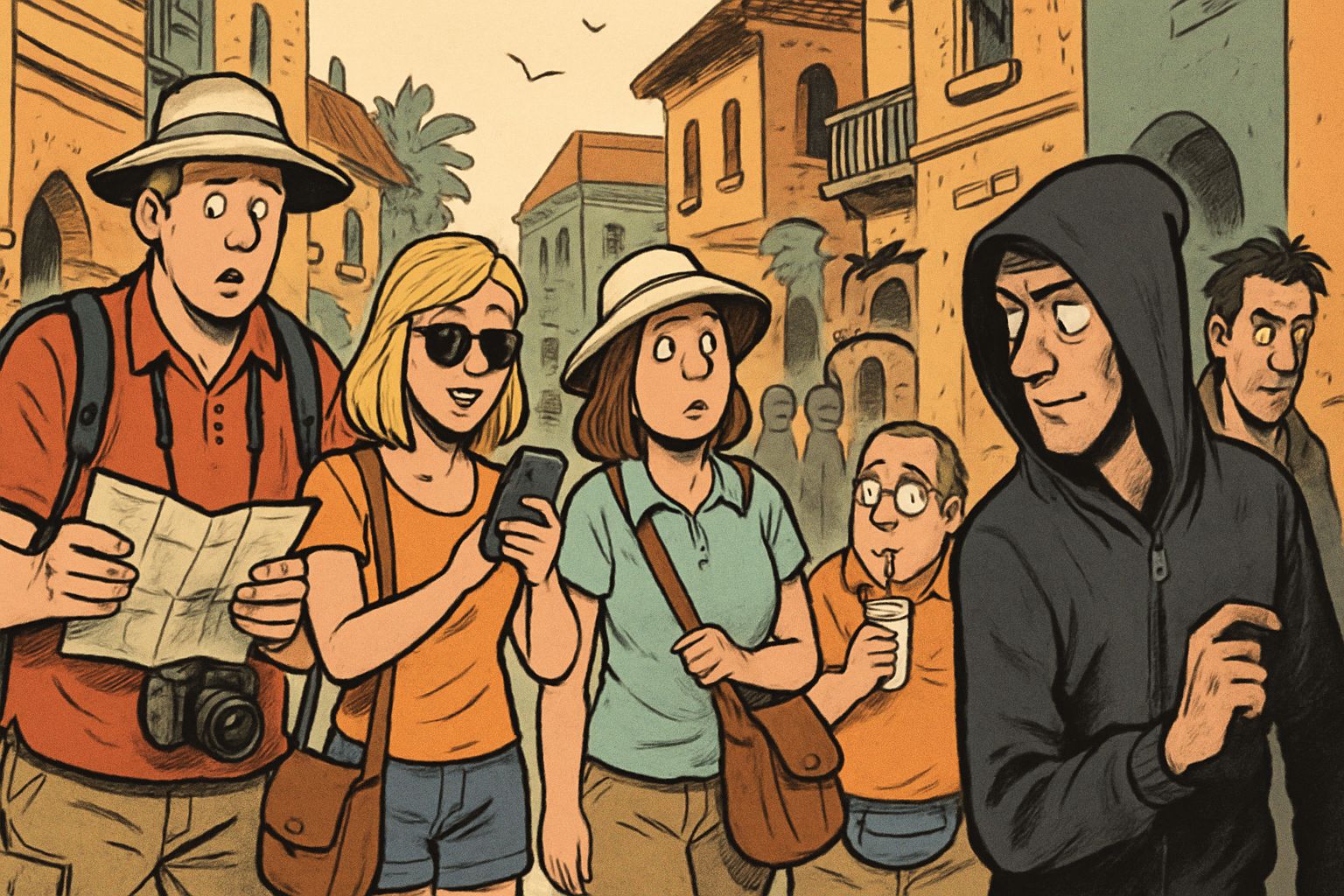
Most travel safety mistakes aren’t made in dark alleyways — they’re made in broad daylight, in crowded markets, on busy buses, and at famous landmarks.
Travelers are uniquely vulnerable. You’re in an unfamiliar environment, often distracted by maps, cameras, or excitement, and you’re likely carrying more valuables than usual — passport, cash, cards, and electronics all at once. That combination makes you a high-value, low-risk target for opportunistic criminals.
The good news? Most of these mistakes are easy to fix once you know what to look for. Here’s what travelers consistently get wrong — and exactly how to do it differently.
Mistake 1: Carrying Valuables the Wrong Way
How you carry your belongings matters more than where you go. Most theft abroad isn’t violent — it’s opportunistic, fast, and silent. Thieves aren’t breaking into hotel safes. They’re reaching into your back pocket while you stare at a menu. To ensure you’re harder to disrupt during your travels, consider how you secure your valuables.
Why Back Pockets Are a Pickpocket’s Best Friend
A wallet in your back pocket is essentially an invitation. It’s out of your line of sight, easy to access in a crowd, and most people don’t feel a skilled pickpocket make contact. The same applies to phones clipped to belt loops, bags worn on one shoulder, and crossbody bags worn with the zipper facing outward. These are low-hanging fruit for anyone looking to steal quickly and disappear into a crowd.
Front pockets are significantly safer for phones and slim wallets. Even better, consider a money belt worn under your clothing for your passport and larger amounts of cash. It takes 30 extra seconds to access — which is exactly the point.
How to Wear and Secure Your Bag in Public
Backpacks are convenient but problematic in crowded spaces. Someone walking behind you can unzip a backpack compartment without you ever noticing. If you’re using a backpack in a busy area, wear it on your front, or choose a bag with locking zippers or slash-proof material. Crossbody bags should be worn with the bag in front of your body and the zipper toward you — not your back.
- Keep wallets and phones in front pockets only
- Use a money belt under your clothes for passports and extra cash
- Wear backpacks on your front in crowded areas
- Choose bags with locking or slash-proof features when possible
- Never leave your bag hanging on the back of a restaurant chair
- Keep luggage and personal belongings in your direct line of sight at all times
The Right Way to Sit on Public Transportation
Where you sit on a bus or train isn’t just a comfort decision — it’s a safety one. Seating near the front of the vehicle, close to the driver, is generally safer and reduces your exposure to theft. Keep your bag on your lap with your hand over the zipper, not stored in the overhead rack or left on the seat beside you.
Mistake 2: Ignoring Your Surroundings in Tourist Areas
The busier and more famous the location, the more your guard tends to drop — and the more someone else’s goes up. Iconic tourist sites are prime targets precisely because they’re crowded and distracting. Ensure your smartphone is actually useful in an emergency to stay alert and prepared in these environments.
Why Tourist Hotspots Have Higher Crime Rates
Pickpockets and scammers specifically operate in high-traffic tourist areas because the conditions are perfect: large crowds, distracted visitors, and a constant flow of new targets who don’t know the local warning signs. Street scams — from “friendship bracelets” to fake petitions — are engineered to distract you while an accomplice lifts your valuables.
Being aware doesn’t mean being paranoid. It means making a habit of scanning your surroundings when you enter a new space, noting who’s nearby, and staying alert to anyone who approaches you unsolicited. Keep your phone in your pocket when you’re not actively using it, even if that means missing a photo opportunity.
Be especially cautious in these common high-risk settings:
- Crowded markets and street fairs
- Public transportation hubs (train stations, bus terminals)
- ATM queues and currency exchange points
- Popular monument and landmark areas
- Outdoor cafes and restaurant patios near busy streets
The Subway Door Theft Trick You Need to Know About
One of the most effective and least-discussed pickpocketing techniques happens on subways and buses right as the doors are closing. A thief will grab your bag, phone, or jacket just as the doors begin to shut — then step off the vehicle as it pulls away. You’re trapped inside, moving in the opposite direction, and they’re already gone. The fix is simple: keep your belongings secured and pulled in close to your body any time you’re near the doors of a train or bus, especially at stops. Additionally, understanding how to become harder to disrupt in everyday life can also enhance your travel safety.
Mistake 3: Taking Unnecessary Road Risks Abroad
Road accidents are one of the leading causes of death for travelers abroad — and unlike pickpocketing, the consequences can be fatal. The U.S. State Department estimates that more than 200 U.S. citizens die each year in road accidents while traveling internationally. Yet most travelers give almost no thought to road safety before they arrive.
Why You Should Avoid Driving in Foreign Countries
Traffic laws vary dramatically from country to country. In many destinations, locals drive on the opposite side of the road, use different signage systems, and operate under entirely different right-of-way rules. Add unfamiliar roads, no data signal for GPS, and the stress of navigating a new city — and the risk compounds fast. Renting a scooter or motorcycle abroad is particularly dangerous, even if you’re experienced at home, because road conditions and driver behavior can be unpredictable.
If you absolutely must drive, research the specific traffic laws of your destination before you go. Check whether your home driver’s license is valid there, or if you need an International Driving Permit (IDP). Many countries require one, and driving without it can result in heavy fines or legal trouble on top of any accident liability.
How to Safely Use Taxis and Public Transportation Abroad
When possible, use vetted transportation options rather than flagging down random vehicles on the street. In many cities, unofficial taxis pose serious safety risks — from overcharging to more dangerous outcomes. Stick to licensed taxis, official ride-share apps like Uber or Grab (which are operational in many international cities), or public transit systems.
- Only use licensed, official taxis or recognized ride-share apps
- Confirm the fare before getting in, or ensure the meter is running
- Share your ride details with someone you trust when traveling alone
- Sit in the back seat of taxis, never the front passenger seat
- Avoid accepting rides from strangers who approach you at airports or stations
Public transportation is generally a safer and more cost-effective option in most major international cities. Research your destination’s transit system before you land — know which lines connect key areas, what a standard fare looks like, and how to identify legitimate transit officials versus imposters.
Pedestrian Dangers That Most Travelers Overlook
Even if you never get behind a wheel, road danger doesn’t disappear. Pedestrian safety is a serious and frequently underestimated risk in many countries. In places where traffic flows on the left side of the road — like the UK, Australia, or Japan — looking the wrong way when crossing a street is a surprisingly common and potentially deadly mistake. For more insights on ensuring safety during emergencies, learn about storm readiness and preparation.
Beyond traffic direction, watch for scooters and motorcycles that ignore pedestrian crossings, vehicles that don’t yield at crosswalks, and unmarked road hazards in less-developed areas. Don’t assume a green pedestrian light guarantees it’s safe to cross — always look both ways regardless.
Quick Reference: Pedestrian Safety by Traffic Direction
Traffic Drives On The Left
Traffic Drives On The Right
United Kingdom
United States
Australia
France
Japan
Germany
India
Mexico
South Africa
Brazil
When in doubt, follow the lead of locals crossing at the same point — and never assume traffic will stop for you.
Mistake 4: Blending In the Wrong Way
Standing out as a tourist isn’t just an aesthetic issue — it’s a safety one. Visible signs that you’re unfamiliar with your surroundings signal opportunity to people who prey on travelers. This doesn’t mean you need to dress like a local in every country you visit. It means being mindful of the signals you’re unintentionally sending.
Tourist Signals That Make You a Target
High-Risk Behavior
Safer Alternative
Holding a paper map open on a street corner
Review routes before leaving your accommodation
Wearing a camera around your neck visibly
Keep camera in a bag until needed
Loudly speaking your native language in public
Lower your voice in crowded public spaces
Flashing expensive jewelry or watches
Leave high-value accessories at home
Wearing branded tourist merchandise
Opt for neutral, understated clothing
The goal isn’t to pretend to be someone you’re not. It’s to avoid broadcasting that you’re unfamiliar with the area, potentially carrying valuables, and less likely to know what to do if something goes wrong. For more tips on staying safe, check out our guide on how to become harder to disrupt in everyday life.
Why Appearing Visibly American Can Make You a Target
Nationality-based targeting is a real phenomenon in certain parts of the world. Travelers who are visibly from wealthy Western nations — particularly Americans — can attract unwanted attention in some destinations, ranging from inflated prices and aggressive scams to, in rare cases, more serious threats. This is especially true in politically sensitive regions or areas with high economic disparity.
This isn’t about being ashamed of where you’re from — it’s about reading the environment and adjusting your visibility accordingly. Avoid wearing clothing with large American flag graphics or logos of U.S. brands in regions where anti-Western sentiment is documented in travel advisories.
How to Blend In With Locals Without Losing Your Identity
Simple adjustments go a long way. Dress in neutral colors that match the general style of the local population. Research local customs around clothing before you arrive — particularly in conservative or religious destinations where showing too much skin can attract unwanted attention or even legal issues. Walk with purpose, keep your phone in your pocket, and if you need to check directions, step into a shop or café rather than stopping in the middle of a busy street.
Mistake 5: Going Out Alone at Night
Nighttime significantly changes the risk profile of any destination. Even cities that feel safe during the day can become less predictable after dark — reduced foot traffic, fewer witnesses, and impaired judgment from alcohol all contribute to increased vulnerability. Traveling in groups at night isn’t just common-sense advice; it’s one of the single most effective ways to deter opportunistic crime. If you do go out alone, share your location with someone you trust, stick to well-lit and populated areas, have your accommodation’s address saved in your phone in the local language, and arrange your return transport before you leave — not after.
Mistake 6: Not Preparing for Environmental Hazards
Personal safety isn’t only about crime. Environmental and health hazards claim just as many travelers — sometimes more — and they’re far less discussed. Preparation here starts weeks before departure, not at the airport.
Packing the Wrong Clothing for the Climate
Underestimating climate conditions is one of the most common pre-trip mistakes. Travelers heading to tropical destinations often pack for heat without accounting for extreme humidity, sudden heavy rainfall, or the temperature drop that comes with air-conditioned interiors. Meanwhile, those heading to mountainous or northern destinations routinely underpack insulation layers, assuming mild weather from a quick online search.
Climate Packing Considerations by Destination Type
Destination Type
Common Mistake
What to Pack Instead
Tropical / Humid
Only packing for heat
Lightweight rain jacket, moisture-wicking layers
High Altitude
Underestimating cold nights
Thermal base layers, windproof outer shell
Desert
Skipping sun protection
UPF clothing, wide-brim hat, high-SPF sunscreen
Cold / Arctic
Relying on a single heavy coat
Layered system: base, mid, and outer shell
Hypothermia, heat exhaustion, and severe sunburn are all genuine medical emergencies that have affected travelers who assumed the weather would be manageable. Check both daytime highs and nighttime lows for your specific travel dates — not seasonal averages — and pack accordingly. For more information on how to prepare for varying weather conditions, explore our guide on storm readiness.
Also consider the activities you have planned. Hiking, water sports, or long days of walking require purpose-appropriate footwear and clothing that casual travel wear won’t provide. Blisters and rolled ankles might sound minor, but they can derail an entire trip — or worse, leave you stranded in a remote location.
Insect-Borne Diseases Travelers Frequently Underestimate
Malaria, dengue fever, Zika virus, and yellow fever are not distant, abstract risks — they are active threats in many of the world’s most popular travel destinations, including parts of Southeast Asia, Central and South America, sub-Saharan Africa, and the Caribbean. Many travelers skip insect protection entirely, or pack a small bottle of low-concentration DEET repellent and consider the problem solved. The reality is more nuanced: effective protection requires the right repellent concentration (at least 20–30% DEET or picaridin), appropriate clothing (long sleeves and pants in high-risk areas at dawn and dusk), and in some cases, prescription antimalarial medication started before you even board the plane.
Natural Disaster Preparedness by Destination
Every destination carries its own environmental risk profile, and ignoring it is a mistake that can turn a bad day into a life-threatening emergency. Earthquake zones, hurricane corridors, flood-prone regions, and active volcanic areas all require destination-specific preparation that goes well beyond packing an umbrella. Before you travel, identify what natural disaster risks exist at your destination and during your specific travel window — hurricane season in the Caribbean runs June through November, monsoon season in Southeast Asia typically peaks between May and October, and wildfire risk in parts of Southern Europe spikes in summer months.
At minimum, know the evacuation routes from your accommodation, save the local emergency number in your phone, and register your trip with the U.S. Embassy in your destination country through the Smart Traveler Enrollment Program (STEP) — a free service that allows the U.S. government to contact you during a regional emergency. It takes less than five minutes to set up and could be the difference between being evacuated and being overlooked.
Mistake 7: Not Researching Your Destination Before You Arrive
Arriving in a foreign country without doing your homework is like walking into a job interview without knowing what the company does — you’re immediately at a disadvantage. Destination research isn’t just about finding the best restaurants or knowing which landmarks to visit. It’s about understanding the risk landscape: what types of crime are common, which neighborhoods to avoid, what local scams are currently circulating, and whether there are any active political or civil unrest situations that could affect your safety.
This research doesn’t need to take days. Even two to three hours of focused reading before departure — pulling from government travel advisories, recent travel forums, and reputable safety-focused resources — can give you a dramatically clearer picture of what to expect on the ground. The travelers who get caught off guard are almost always the ones who assumed their destination was safe without ever actually checking.
Know what documents you need before you land. Understand the local laws — including things that are legal at home but illegal abroad, such as certain medications, photography in government areas, or specific types of public behavior. In some countries, ignorance of local law is not a valid legal defense, and the consequences of violations can be severe. To avoid such situations, it might be helpful to create a neighborhood contact list before an emergency happens, ensuring you have local contacts who can assist you.
How to Use U.S. State Department Travel Advisories
The U.S. Department of State publishes Travel Advisories for every country in the world, rated on a four-level scale: Level 1 (Exercise Normal Precautions), Level 2 (Exercise Increased Caution), Level 3 (Reconsider Travel), and Level 4 (Do Not Travel). These advisories are updated regularly and include specific detail about crime rates, civil unrest, health risks, and entry requirements. You can access them directly at travel.state.gov — search your destination country and read the full advisory, not just the headline level. Regional breakdowns within a country are particularly useful, as safety conditions can vary significantly between a capital city and rural areas.
Knowing the Local Emergency Number Before You Land
Assuming that 911 works everywhere is one of the most dangerous assumptions a traveler can make. Emergency numbers vary by country — in the UK it’s 999, across most of Europe it’s 112, in Australia it’s 000, and in Japan it’s 110 for police and 119 for fire and ambulance. The U.S. State Department publishes a reference guide to international emergency numbers that you can download and save to your phone before departure.
Write the local emergency number down. Save it in your phone contacts. Share it with anyone traveling with you. In a genuine emergency — whether medical, criminal, or environmental — fumbling through a Google search to find the right number costs time you may not have. This is a 30-second preparation step with potentially life-saving consequences.
One Simple Rule That Prevents Most Travel Safety Mistakes
If there’s one principle that cuts across every category of travel safety, it’s this: stay aware, and plan ahead. The vast majority of incidents that happen to travelers abroad — theft, scams, road accidents, health emergencies — are not random, unavoidable events. They’re the predictable result of distraction, overconfidence, or a lack of preparation. The traveler who researches their destination, secures their valuables, stays alert in public spaces, travels in groups at night, and knows what to do in an emergency is statistically far less likely to become a victim of anything.
Awareness is a habit, not a personality trait. It can be built through small, consistent actions: checking advisories before you book, reviewing your route before you leave your hotel, keeping your bag in front of you in crowds, and trusting your instincts when something feels off. The goal isn’t to travel in fear — it’s to travel smart, so that your experience abroad is defined by the places you saw and the things you did, not the problems you ran into.
Frequently Asked Questions
Here are answers to the most common questions travelers ask about personal safety abroad.
What Is the Most Common Safety Mistake Travelers Make Abroad?
The most common mistake is failing to secure valuables properly in public spaces. Carrying a wallet in a back pocket, wearing a backpack without securing the zippers, or leaving a bag on the back of a chair in a restaurant are all habits that make opportunistic theft effortless for experienced pickpockets. These mistakes happen in broad daylight in busy tourist areas — not just in dark or dangerous neighborhoods.
Close behind that is a lack of destination research. Travelers who arrive without checking current travel advisories, understanding local laws, or knowing which areas to avoid are significantly more vulnerable to both crime and avoidable accidents. A few hours of preparation before departure addresses both issues almost entirely.
Is It Safe to Hail a Taxi on the Street in a Foreign Country?
In many countries, hailing a random taxi off the street carries real risk — from price gouging and deliberate detours to, in some destinations, more serious safety concerns. The safest approach is to use only licensed taxi companies recommended by your hotel or accommodation, or to use a verified ride-share app like Uber or Grab where available. If you do use a street taxi, always confirm the fare before getting in or ensure the meter is running, and sit in the back seat rather than the front.
When arriving at international airports, be particularly cautious of people who approach you in the arrivals hall offering taxi services. Use only the officially designated taxi queue or a pre-booked transfer arranged through your accommodation. Unofficial airport taxis are one of the most common and well-documented tourist scams worldwide.
What Should I Do If I Become a Victim of Theft While Traveling?
Report the theft to local police as soon as possible and obtain a written police report — you’ll need this for any insurance claim. Contact your bank immediately to freeze or cancel any compromised cards. If your passport was stolen, contact the nearest U.S. Embassy or consulate to begin the emergency passport replacement process. Keep digital and physical copies of your passport stored separately from the original for exactly this reason. For additional safety, ensure your smartphone is useful in an emergency by storing important contacts and information securely.
How Do I Find Out If My Travel Destination Has an Active Safety Advisory?
Visit travel.state.gov and search for your destination country to access the most current U.S. State Department Travel Advisory. You can also sign up for email alerts through the Smart Traveler Enrollment Program (STEP) to receive automatic updates if conditions change while you’re abroad.
Should I Buy Travel Insurance Before an International Trip?
Yes — travel insurance is one of the most practical safety decisions you can make before any international trip. A comprehensive policy covers medical emergencies (including emergency evacuation, which can cost tens of thousands of dollars without coverage), trip cancellation, lost or stolen belongings, and in some cases, security evacuation in the event of civil unrest or natural disaster.
When comparing policies, pay close attention to the medical coverage limit, whether emergency evacuation is included, and any exclusions related to pre-existing conditions or high-risk activities like adventure sports. A policy that covers at least $100,000 in medical expenses is a reasonable baseline for most international travel.
Some credit cards offer limited travel insurance as a benefit, but the coverage is typically far narrower than a dedicated travel insurance policy. Read the fine print carefully before assuming your credit card coverage is sufficient, particularly for medical emergencies or extended trip disruptions.




Leave a Reply