
Article-At-A-Glance
- Every child should memorize their full name, home address, and at least one parent’s phone number before an emergency ever happens.
- Families who practice their emergency plan regularly raise kids who stay calm and take action instead of freezing up in a crisis.
- Building a kid-friendly emergency kit together is one of the most effective ways to make preparedness feel real and empowering, not scary.
- Your reaction during an emergency directly shapes how your child responds — staying calm is one of the most powerful things you can do.
- There are five surprisingly fun ways to teach kids emergency skills without triggering anxiety — keep reading to find out what they are.
Most kids have no idea what to do in an emergency — and that’s not their fault, it’s a gap most families don’t realize exists until it’s too late.
Emergency preparedness for kids isn’t about scaring them. It’s about giving them the knowledge, confidence, and tools to act when it matters most. The American Red Cross recommends involving children directly in disaster planning — not just telling them what to do, but practicing it alongside them so the response becomes second nature.
Empower Emergency specializes in helping families build preparedness plans that actually work for kids of all ages, offering guidance that makes this process straightforward and stress-free for parents.
Every Parent Needs to Read This
There’s a critical difference between a child who has heard about what to do in an emergency and one who has practiced it. One freezes. The other acts. The research and guidance from organizations like the American Red Cross make this distinction clear: knowledge without practice is incomplete preparation.
Why Kids Need Their Own Emergency Plan
Adults aren’t always present when emergencies strike. A child could be at school, at a friend’s house, or even home alone when something goes wrong. That’s exactly why kids need more than a vague idea of what emergencies are — they need a personal, practiced plan they can execute on their own.
Key Insight: Children who participate in creating their family’s emergency plan are significantly more likely to remember and follow it under stress. Involving them in the process builds ownership and confidence.
Think of it like a fire drill at school. Kids don’t just learn about fire safety — they walk the route, they know the sound of the alarm, and they know exactly where to go. Your home plan should work the same way.
The Difference Between Knowing and Being Ready
Knowing that you should call 911 is very different from knowing what to say when the dispatcher picks up. Being ready means your child can state their full name, address, and the nature of the emergency clearly — even while scared. That level of readiness only comes from practice, not from a single conversation. For more tips on preparing your family, check out how families can prepare for emergencies.
What Every Child Should Know Before an Emergency Happens
Before you build a kit or map out meeting points, there’s a foundation of core knowledge every child needs locked in. These aren’t complex skills — they’re simple, repeatable facts that can be drilled through everyday conversation and games.
Full Name, Address, and Parent Contact Numbers by Heart
This is step one. Every child old enough to talk should be working toward memorizing their full name, their home address, and at least one parent’s phone number. For younger kids who can’t memorize yet, the American Red Cross suggests writing this information on a small index card that can be clipped to their shirt or tucked into a pocket.
Practice this casually at dinner or during car rides. Turn it into a quick quiz: “Hey, what’s our address?” Make it normal, not stressful. By the time it’s needed, the answer should come automatically.
Tip for Young Children: Use a laminated card with the child’s name, parent names, home address, and two emergency phone numbers. Attach it to their backpack or keep it in their jacket pocket at all times.
How to Call 911 and What to Say
Children should practice, out loud, exactly what they would say when calling 911. Walk them through the process: stay on the line, speak slowly, give your name and address first, then explain what’s happening. Role-play this scenario more than once so it becomes a familiar script rather than a panic-inducing unknown.
The Family Meeting Spot and How to Get There
Every family needs a designated emergency meeting point — and every child needs to know how to get there from both home and school. Take a physical walk to this spot with your kids. Don’t just describe it. Walk the route together, talk about landmarks, and make sure they can find it independently.
Also establish a backup meeting spot in case the primary location isn’t accessible. Discuss who the family’s out-of-area emergency contact is, since local phone lines can get overloaded during disasters while long-distance calls sometimes go through more reliably. For more tips on emergency preparedness, consider checking out this budget survival gear list.
How to Build a Family Emergency Plan Kids Can Follow
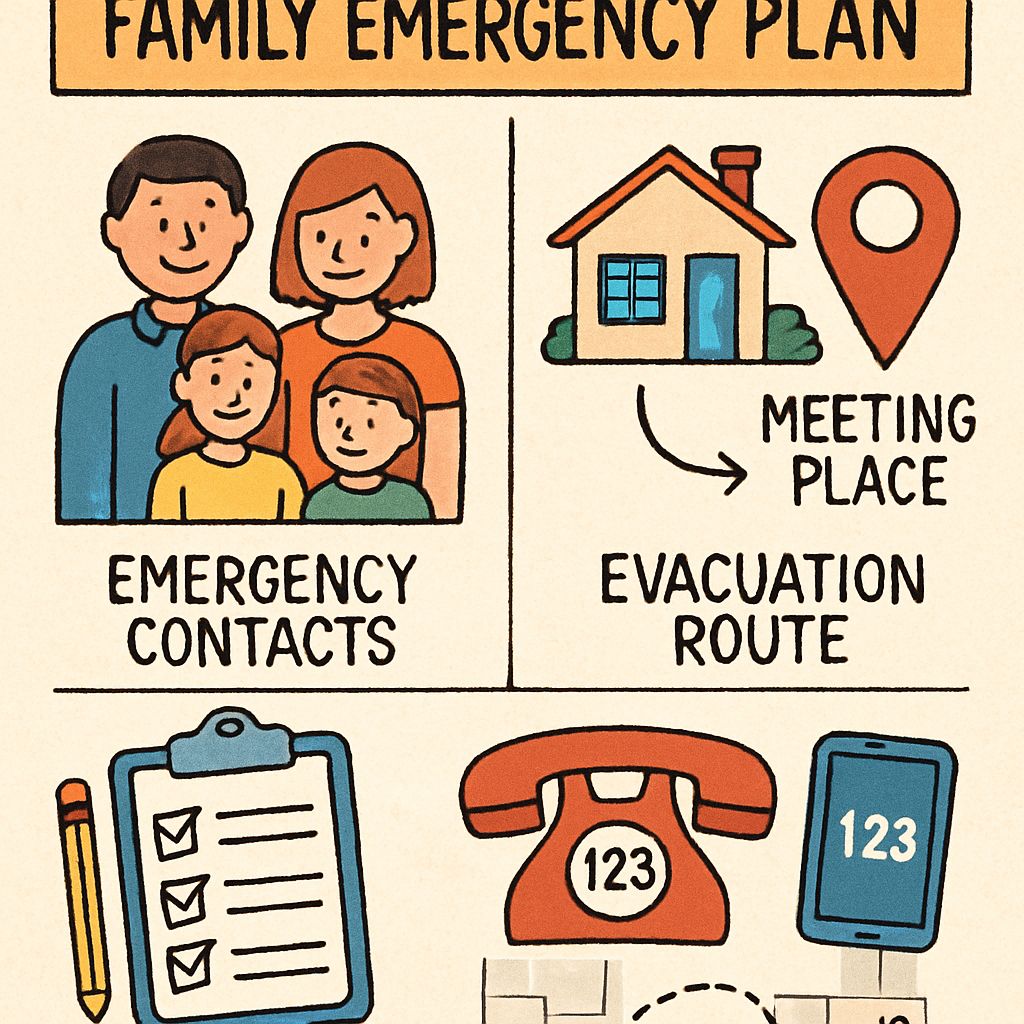
A solid family emergency plan isn’t a document you file away — it’s a living, practiced system that every member of your household knows by heart. When you build it with your kids rather than for them, it becomes something they trust and remember.
Walk the Route to Your Emergency Meet-Up Point
Don’t skip the physical walk. Talking about the meeting spot is one thing — navigating there under stress is another. Walk the route during daylight, and if your kids are older, consider doing it at night too. Point out landmarks, discuss alternate paths, and let your kids lead the way once they’ve learned the route. For more tips on engaging kids in emergency readiness, explore additional resources available online.
Check Emergency Plans at School and Daycare
Your home plan needs to align with what your child’s school or daycare is already doing. Contact your child’s school to find out:
- What their emergency evacuation procedures look like
- Where children are taken if the school building must be evacuated
- How and where parents can pick up children during an emergency
- Whether the school has a lockdown or shelter-in-place protocol
Once you know the school’s plan, reinforce it at home. If the school teaches specific procedures, practice those same steps so your child gets consistent messaging from every environment they’re in.
Assign Age-Appropriate Roles to Each Child
One of the most powerful things you can do is give each child a specific job in your family emergency plan. When kids have a defined role, they feel capable instead of helpless. It also distributes responsibility in a way that keeps the whole family functioning under pressure.
- Ages 3–5: Know their full name and practice staying with a trusted adult. Their job is to follow instructions and hold a parent or older sibling’s hand.
- Ages 6–9: Memorize the family address, one parent phone number, and know the meeting spot. Can help carry a small personal emergency backpack.
- Ages 10–12: Can help younger siblings during evacuation, know how to call 911, and assist with grabbing the emergency kit.
- Ages 13+: Take on near-adult roles — leading younger kids to the meeting spot, knowing how to shut off utilities, and acting as a secondary emergency contact.
Framing these roles as important family responsibilities rather than scary tasks makes a real difference in how kids receive them. A 10-year-old who knows they’re in charge of grabbing the flashlights and walking their little sister to the meeting point feels trusted, not burdened. For more on preparing for emergencies, check out this essential bug out bag list.
Revisit and update these roles as your children grow. A plan that fits a 7-year-old won’t serve that same child at 12. Make role updates part of your regular family plan review, ideally every six months or after any major household change.
What Goes in a Kid-Friendly Emergency Kit
An emergency kit isn’t just a box of supplies — it’s a physical symbol that your family is prepared. When kids help build it, it stops being a scary concept and becomes something concrete and reassuring. They know what’s in it, where it is, and why each item matters.
The goal is to build a kit that covers your family for at least 72 hours without outside assistance. FEMA and the American Red Cross both recommend this as the baseline. That means enough water, food, light, and first aid supplies to keep your family safe while emergency services respond and stabilize the situation.
Essential Supplies Every Kit Needs
|
Item |
Quantity Guideline |
Purpose |
|---|---|---|
|
Water |
1 gallon per person per day (3-day minimum) |
Drinking and sanitation |
|
Non-perishable food |
3-day supply per person |
Nutrition without refrigeration |
|
Flashlight + extra batteries |
One per family member |
Navigation during power outages |
|
First aid kit |
One fully stocked kit |
Treating minor injuries |
|
Whistle |
One per child |
Signal for help if trapped |
|
Emergency contact card |
One per child |
ID and contact info if separated |
|
Dust masks |
One per person |
Protection from air contaminants |
|
Battery-powered or hand-crank radio |
One per household |
Receive emergency broadcasts |
Let Kids Personalize Their Own Kit
Give each child their own small backpack to pack as their personal emergency kit. Let them include a comfort item — a small stuffed animal, a favorite book, or a family photo. This single act transforms the kit from something clinical and adult into something that belongs to them. Add their emergency contact card, a snack they like, a small flashlight, and a whistle, and you’ve built a kit they’ll actually want to grab in a hurry. For more ideas, explore this survival gear list that can be useful for any emergency situation.
How to Teach Kids Emergency Preparedness Without Scaring Them
The biggest mistake parents make is sitting kids down for a serious, heavy conversation about disasters. That approach almost always backfires — especially with younger children — triggering anxiety instead of confidence. The better approach is to weave preparedness into activities that feel normal, fun, and low-stakes. For more ideas, check out how Oregon engages kids in emergency readiness.
1. Role-Playing Scenarios
Pick a specific emergency scenario — a house fire, an earthquake, a severe storm — and walk through it together as a family. Assign roles, practice the steps out loud, and then debrief afterward. Ask your kids what felt easy and what felt confusing. Role-playing builds muscle memory and gives kids a mental script to pull from when real stress hits. Keep these sessions short, upbeat, and focused on what goes right when everyone follows the plan. For additional preparedness, consider learning about essential survival gear that can be useful in emergencies.
2. Emergency Drill Obstacle Course
Turn your home evacuation drill into a timed obstacle course. Set up the route from each bedroom to the front door and out to the meeting spot, then time each family member. Kids love the challenge of beating their own time. Add elements like grabbing the emergency kit, helping a younger sibling, or finding the flashlight in the dark. Making it competitive and physical locks in the route far better than any verbal explanation ever could.
3. Scavenger Hunt for Kit Supplies
Before you assemble your emergency kit, create a scavenger hunt where kids find items around the house that belong in it — bottled water from the pantry, batteries from the junk drawer, a first aid kit from the bathroom cabinet. Give them a checklist and a time limit. The act of physically locating and handling these items makes the kit feel familiar rather than foreign when it’s actually needed. For more ideas on how to make preparedness fun, check out engaging kids in emergency readiness.
4. Story Time With Emergency Themes
For younger children especially, stories are one of the most effective teaching tools available. Read books where characters face emergencies and make smart choices. After reading, ask simple questions: “What did she do when the storm came? What would you do?” This approach introduces emergency concepts at an emotional distance, making it easier for kids to process without feeling overwhelmed. The American Red Cross offers free preparedness resources designed specifically for young readers.
5. Quiz Games and Flashcards
Create a set of emergency preparedness flashcards with questions on one side and answers on the other — things like “What’s our home address?”, “Where’s our meeting spot?”, and “What do you do if you smell smoke?” Turn it into a quick daily quiz during breakfast or a car ride. Kids who can answer these questions without thinking are kids who will answer them correctly under pressure.
How to Guide Kids During an Active Emergency
When a real emergency unfolds, your children’s emotional response will mirror yours more than you might expect. Research and guidance from the American Red Cross consistently emphasize this: children look directly to their caregivers for cues on how to feel and how to act. A calm, focused parent signals safety even in the middle of chaos. That doesn’t mean pretending everything is fine — it means demonstrating that you have a plan and you’re executing it. Speak in a steady voice, move with purpose, and give your children clear, simple instructions one step at a time.
Your Reaction Sets the Tone for Theirs
Children are extraordinarily perceptive. Even toddlers pick up on tension in a parent’s voice, body language, and facial expression. During an emergency, if you panic visibly, your child’s nervous system interprets that as confirmation that something is truly beyond control — and they shut down or escalate emotionally. Your calm is literally contagious, and so is your fear. For more insights on maintaining composure in challenging situations, explore building confidence and self-defense psychology.
Practice keeping your voice low and even during drills so that tone becomes your default under pressure. Use simple, direct language: “We’re going to the meeting spot now. Grab your backpack. I’m right here.” Short sentences. Clear actions. No room for ambiguity. The more practiced this feels at home, the more naturally it comes out when the stakes are real. Make sure your bug-out bag items are ready to grab in emergencies.
Keep Routines Intact as Much as Possible
After an emergency — even a minor one — children recover faster when familiar routines are restored quickly. Regular mealtimes, bedtime rituals, and daily structure signal to a child’s brain that safety has returned. If you’re sheltering in place or displaced temporarily, recreate as much of your normal routine as the situation allows. Read the same bedtime story. Eat meals together. Keep the rhythm. For more tips on preparedness, check out this essential bug-out bag list.
What to Say When Kids Are Scared
Don’t dismiss fear or tell children not to worry. Instead, acknowledge it directly: “I know this is scary. I feel it too. And we have a plan, and we’re following it right now.” That combination — validating the emotion while reinforcing competence — is exactly what helps children move through fear rather than get stuck in it.
Avoid over-explaining or sharing adult-level details about the danger. Kids need to know enough to cooperate with the plan, not everything you know about the threat. Keep communication age-appropriate, honest, and action-focused. “Here’s what we’re doing right now” is almost always more reassuring than a detailed explanation of what could go wrong.
Building Resilience That Lasts Beyond the Emergency
Preparedness isn’t a one-time event — it’s an ongoing practice that builds something far more valuable than a stocked kit or a memorized address. It builds resilience. Children who grow up knowing how to assess a situation, follow a plan, and support their family in a crisis carry those skills into every challenge they face as adults. The American Red Cross describes this as building resilience through coping skills — and the foundation is laid long before any emergency ever occurs. Every drill, every kit-building session, every casual quiz at the dinner table is a deposit into that resilience account.
Kids Who Practice Are Kids Who Are Ready
The gap between a child who panics and a child who acts comes down to one thing: practice. Not perfect practice, not elaborate training — just regular, repeated exposure to the plan until it feels as natural as buckling a seatbelt. Review your family emergency plan every six months. Update it when kids change schools, when the family moves, or when roles need to shift as children grow older.
Make it a family habit, not a family chore. The families who treat preparedness as part of normal life — not something reserved for scary conversations — raise kids who are genuinely equipped to handle what comes. That’s the goal. Not fear. Not anxiety. Capability.
Frequently Asked Questions
Here are answers to the most common questions parents ask when getting started with emergency preparedness for kids.
Quick Reference: Emergency Preparedness by Age
Ages 3–5: Learn full name, stay with trusted adults, practice following simple instructions.
Ages 6–9: Memorize home address and one parent phone number, know the meeting spot, carry a personal kit.
Ages 10–12: Call 911 independently, assist younger siblings, help grab the emergency kit.
Ages 13+: Lead evacuation of younger children, know utility shutoffs, serve as secondary emergency contact.
Every child develops differently, so use these ranges as guidelines rather than strict rules. A mature 9-year-old may be ready for 10–12 responsibilities, while a child with special needs may require adjusted expectations and additional support built directly into your family plan.
If your child has a medical condition, a disability, or specific emotional needs, factor those into every element of your emergency planning — from kit contents to communication strategies. FEMA recommends that families with members who have access or functional needs create a personal support network of neighbors, friends, or caregivers who know the plan and can assist if needed.
The best emergency plan is one that reflects your actual family — not a generic template. Start there, customize it, practice it, and update it regularly.
At What Age Should You Start Teaching Kids About Emergency Preparedness?
You can start as early as age 3 with the most basic concepts — knowing their name, staying with a trusted adult, and recognizing the sound of a smoke alarm. By age 5 or 6, most children are ready to begin memorizing their home address and understanding what a family meeting spot is. The key is matching the complexity of the information to the child’s developmental stage.
Don’t wait until you think your child is “old enough” to handle it. Simple, calm, age-appropriate preparedness conversations started early normalize the topic and prevent the kind of fear that comes from encountering it for the first time in an actual emergency.
How Often Should Families Practice Their Emergency Plan?
The American Red Cross recommends practicing your family emergency plan at least twice a year. A good rhythm is to tie drills to daylight saving time changes — the same reminder used for changing smoke alarm batteries. That gives you a built-in calendar trigger that’s easy to remember. Additionally, consider including essential bug-out bag items in your preparedness plan for comprehensive safety.
Beyond formal drills, weave informal practice into everyday life. Quiz kids on the meeting spot during car rides. Ask your child to show you where the emergency kit is kept. Run a quick fire drill without warning once or twice a year so kids experience the pressure of responding without preparation time. That unannounced element is where real readiness gets tested.
What Should Be in a Child’s Personal Emergency Kit?
A child’s personal emergency backpack should be lightweight enough for them to carry independently and stocked with items they recognize and feel comfortable with. At minimum, include a small flashlight, a whistle, a sealed snack, a water bottle, an emergency contact card with name and phone numbers, and one comfort item like a small stuffed animal or a family photo.
For children with medical needs, add any essential medications with clear labeling, a copy of their prescription, and a brief medical information card that emergency responders can read quickly. Store this kit somewhere the child can access it on their own — typically near their bedroom door or in a spot they pass every day.
How Do You Talk to Kids About Emergencies Without Causing Fear?
Keep the conversation focused on capability, not catastrophe. Instead of describing what disasters look like, talk about what your family does — “Here’s our plan, here’s your job, here’s where we go.” Frame drills as practice for being smart and prepared, the same way athletes practice for a game. Avoid graphic descriptions of injury or destruction, and always end preparedness conversations on an empowering note: your family has a plan, you’ve practiced it, and everyone knows what to do.
What Should a Child Do if They Are Alone During an Emergency?
This is one of the most important scenarios to practice, because it’s also one of the most likely. Children are regularly at school, a friend’s house, or home alone when emergencies happen. Teach your child a simple three-step rule: Stay Calm. Follow the Plan. Get to Safety. For guidance on what to include in an emergency plan, check out this essential bug-out bag items list.
If they’re at home alone, they should know to call 911 first if there’s immediate danger, then follow the household evacuation plan to the family meeting spot. If they’re at school, they follow the school’s procedures — which is exactly why aligning your home plan with your school’s plan is so critical. Make sure your child knows the name and number of a trusted neighbor or nearby adult they can go to if they can’t reach you.
Practice this scenario out loud with your child at least once. Ask them: “What would you do if there was a fire and I wasn’t home?” Walk through their answer together, correct any gaps, and reinforce the steps until they can recite them without hesitation. That conversation could be the most important one you ever have. For more family-centered emergency preparedness resources and tools, Empower Emergency provides practical guidance designed to help families build real-world readiness that sticks.




Leave a Reply