
- Water, food, shelter, skills, and self-defense are the five pillars of personal preparedness — and a gap in any one of them is a gap in your survival plan.
- The human body can survive only three days without water, making it the most time-critical pillar to address first.
- Most people overlook shelter because they assume they’ll always have a home to return to — disasters like wildfires and floods prove otherwise every year.
- Building all five pillars doesn’t require a large budget — strategic, incremental steps can get you prepared without financial strain.
- Your health is the silent foundation beneath every pillar — keep reading to find out why it matters more than any piece of gear you own.
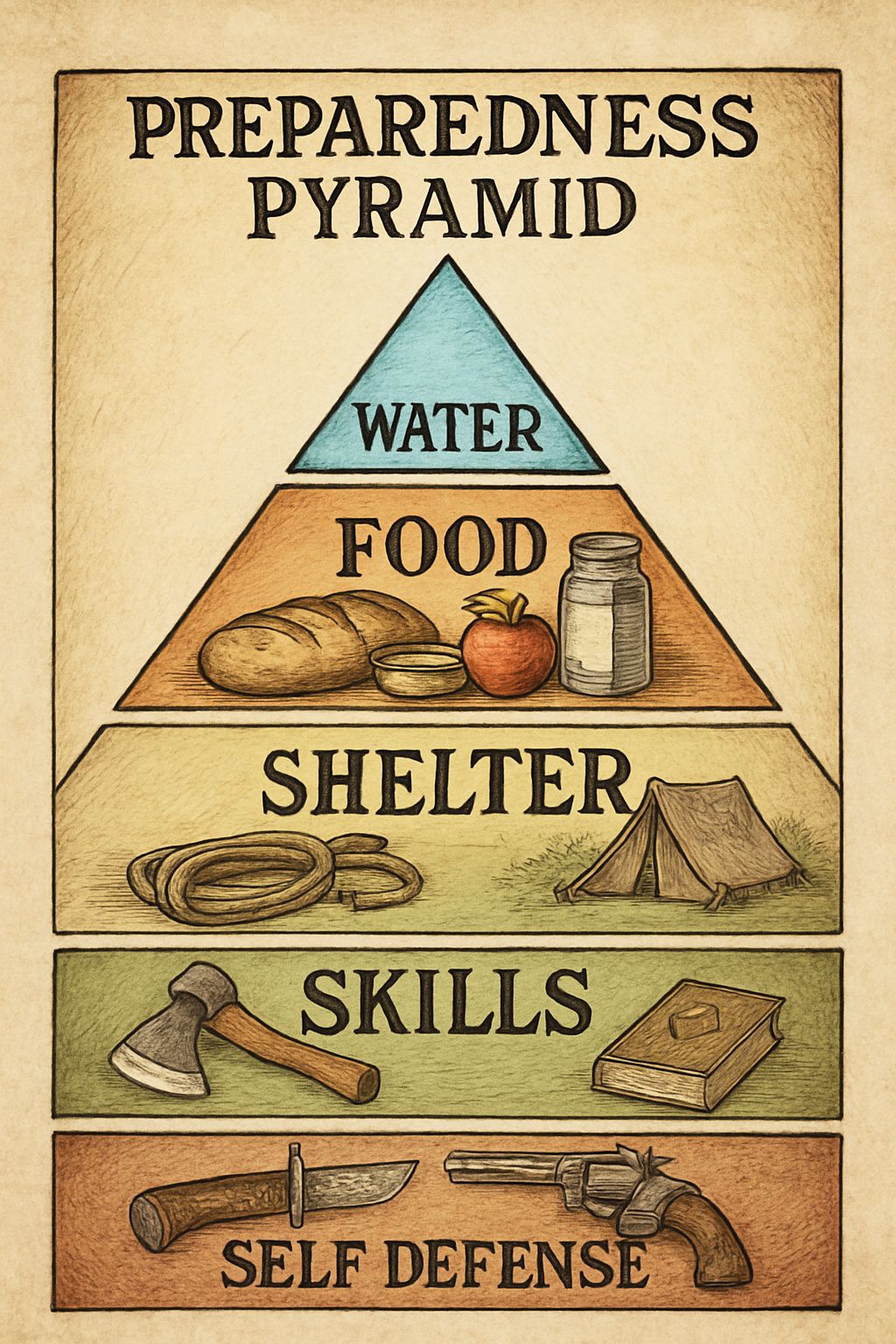
Most emergencies aren’t complicated — they’re just five basic problems hitting you at the worst possible time.
Whether you’re facing a three-day power outage, a wildfire evacuation, or a long-term disruption to supply chains, every survival situation traces back to the same set of core needs. Understanding those needs — and preparing for them before disaster strikes — is what separates people who manage crises from people who are consumed by them. The framework that makes this simple is called the five pillars of personal preparedness.
Every Disaster Comes Down to These 5 Things
Survival experts and emergency management professionals have long used pillar-based frameworks to simplify preparedness. The idea is straightforward: like legs on a table, remove one pillar and the whole structure becomes unstable. Every disaster scenario — regardless of cause or scale — will test you on water, food, shelter, skills, and self-defense. These aren’t arbitrary categories. They map directly to what the human body and mind need to function under pressure.
These five fundamentals also align with the well-known Survival Rule of Threes:
- 3 hours without shelter (in extreme conditions) before core body temperature becomes life-threatening
- 3 days without water before the body begins to shut down
- 3 weeks without food before starvation becomes critical
- 3 months without human companionship before psychological resilience deteriorates
These pillars or fundamentals take this survival science and turn it into something actionable for everyday life. You don’t need to be a wilderness expert or spend thousands of dollars. You just need a clear picture of each pillar and an honest assessment of where your gaps are.
Fundamental 1: Water
Water is non-negotiable. It is the first pillar for a reason — no other resource becomes critical faster. You can push through hunger, improvise shelter, and negotiate a threat. But you cannot negotiate with dehydration.
How Long the Body Survives Without Water
The body can survive approximately three days without water under normal conditions — but that window shrinks fast in heat, physical exertion, or stress. All three of those conditions are common in disaster scenarios. Within 24 hours of inadequate hydration, cognitive function begins to decline, which is precisely when you need to be making your clearest decisions. It’s crucial to avoid preparedness mistakes that could worsen the situation.
How Much Water to Store Per Person
The standard recommendation from emergency management guidance is one gallon of water per person, per day. That accounts for drinking and basic sanitation. A two-week supply for a family of four means storing 56 gallons — which sounds like a lot until you realize that stackable water storage containers like the WaterBOB bathtub bladder (100-gallon capacity) or the Augason Farms 55-Gallon Water Barrel can make this manageable even in small spaces.
Start with a 72-hour minimum if you’re just beginning. That’s roughly three gallons per person. From there, work toward a two-week supply as your target baseline. Once you hit a month of stored water, pairing storage with collection and filtration systems dramatically extends your capability without requiring more storage space. For more information, check out this guide on personal preparedness.
Safe Water Sources When Supplies Run Out
Stored water won’t last forever, and supply lines can stay disrupted longer than expected. Knowing how to source and treat water from the environment is what separates short-term survival from long-term resilience. Rainwater collection paired with a quality filtration system — like the Sawyer Squeeze Filter or the Berkey countertop gravity filter — can provide a continuous water source. Boiling remains the most reliable purification method when in doubt, killing pathogens that even some filters miss.
Fundamental 2: Food
Food is the second pillar, and while it’s less immediately urgent than water, it has a compounding effect on morale, energy, and decision-making over time. A hungry mind makes poor choices — and poor choices in a crisis carry real consequences.
How Long the Body Survives Without Food
The human body can survive up to three weeks without food, but performance degrades well before that point. Energy levels drop, irritability increases, and the immune system weakens — none of which are ideal when you’re managing an emergency. This is why food storage is about sustaining function, not just avoiding starvation.
The Best Foods to Store for Emergencies
The best emergency foods share three traits: long shelf life, high caloric density, and minimal preparation requirements. Freeze-dried meals from brands like Mountain House or Augason Farms offer 25-to-30-year shelf lives and only require water to prepare. Canned goods, white rice, dried beans, rolled oats, honey, and hard winter wheat round out a well-balanced pantry that won’t require refrigeration.
How to Rotate Your Food Supply So Nothing Goes to Waste
The most practical rotation strategy is the FIFO method — First In, First Out. Place newer purchases behind older stock and always consume from the front. Label everything with the purchase or open date using a permanent marker. For households just getting started, the simplest approach is to build your emergency food supply around items you already eat regularly, so rotation happens naturally as part of your weekly meals rather than as a separate project.
Fundamental 3: Shelter
Shelter is your protection from the environment — and the environment can kill you in as little as three hours under the wrong conditions. Extreme cold, driving rain, or brutal heat can push your core body temperature to dangerous levels faster than most people realize. Before you think about food or even water in a true survival scenario, your body needs to be thermally protected.
Shelter preparedness has two distinct dimensions: your primary shelter (your home) and your contingency shelter when home is no longer an option. Most people have thought about the first and almost none have prepared for the second. That gap is where people get into serious trouble during wildfires, floods, and chemical spills that force rapid evacuation.
Why Shelter Is Often the Most Overlooked Pillar
People overlook shelter preparedness because home feels permanent. It isn’t. The 2018 Camp Fire in Paradise, California destroyed more than 18,000 structures in under 24 hours — leaving residents with no shelter and no plan. The assumption that your home will always be there is one of the most dangerous assumptions you can make in emergency planning. A shelter contingency plan should be treated as a non-negotiable part of your preparedness strategy, not an afterthought.
At minimum, your shelter preparedness kit should include options for both staying and going. For home reinforcement, consider thermal emergency blankets, blackout curtains for heat management, and weatherproofing supplies. For evacuation scenarios, a quality four-season tent like the MSR Access 2 or a tarp shelter system gives you a deployable option that fits in the back of a vehicle. Avoid preparedness mistakes by ensuring your kit is comprehensive and versatile.
Shelter-in-Place vs. Evacuation: How to Decide
The decision to stay or go should never be made in the moment — it should be pre-decided based on clearly defined trigger conditions. If local authorities issue a mandatory evacuation order, you leave. If the threat is external (civil unrest, airborne contamination) and your home is structurally sound and stocked, sheltering in place may be the safer choice. Build a simple decision tree before any emergency occurs, and share it with every member of your household so the plan executes automatically under pressure.
Fundamental 4: Skills
Gear without skills is just expensive clutter. This is the pillar that most preparedness checklists underemphasize — and it’s the one that actually determines outcomes when everything goes sideways. A water filter is only useful if you know how to use it. An emergency radio only helps if you know what frequencies to monitor. Skills are the pillar that makes every other pillar work.
The core skills every prepared individual should develop fall into a few clear categories. First aid and CPR certification through the American Red Cross is a foundational starting point — knowing how to manage bleeding, shock, and cardiac events saves lives in scenarios where emergency services are delayed or unavailable. Navigation skills, both map-and-compass and digital GPS, ensure you can move safely regardless of whether cell networks are operational.
Beyond those fundamentals, fire-starting, basic water purification, food preservation, and communication skills round out a practical skill set for most emergency scenarios. The Tiny Survival Guide — a compact, laminated reference card — is one of the most practical tools available for condensing critical survival knowledge into a portable format. But reference cards supplement skills; they don’t replace them. The best investment you can make in your preparedness plan is time spent practicing, not just reading.
Fundamental 5: Self-Defense/Protection
Self-defense is the pillar that makes people uncomfortable — and that discomfort is exactly why it gets skipped. But the reality of disaster scenarios is that social order can deteriorate quickly, and the people least prepared to protect themselves and their supplies are the most vulnerable. Self-defense preparedness isn’t about aggression. It’s about not being a target.
This pillar operates across three levels: awareness, deterrence, and response. Most threats never escalate to physical confrontation if you’ve handled the first two levels effectively. Understanding how threats develop and presenting yourself as a confident, aware, and prepared individual eliminates the majority of risk before it ever becomes a physical situation. To enhance your skills, consider developing situational awareness without becoming paranoid.
Situational Awareness as Your First Line of Defense
Situational awareness means knowing what’s happening around you before it becomes a problem. Security professionals use a simple color-coded system originally developed by Lt. Col. Jeff Cooper — White (unaware), Yellow (relaxed alertness), Orange (specific alert), and Red (action). In everyday life, most people operate in White. In an emergency, you should be operating in Yellow at minimum, at all times.
Practically speaking, situational awareness means positioning yourself with sightlines to exits, noticing behavioral anomalies in the people around you, and trusting your instincts when something feels wrong. These are trainable habits, not innate abilities. Regular practice in low-stakes environments builds the pattern recognition you’ll need when stakes are high.
It also means protecting information. Advertising that you have two weeks of food storage and a generator during a neighborhood power outage turns you into a target. Operational security — keeping your preparedness level private — is a form of self-defense that costs nothing and reduces risk significantly.
Physical vs. Tool-Based Self-Defense Options
Physical self-defense training through disciplines like Krav Maga or Brazilian Jiu-Jitsu gives you capability that cannot be taken away or lost. Tool-based options — including pepper spray, personal alarms, and legally owned firearms — extend that capability, but each comes with legal considerations and training requirements that must be addressed before an emergency occurs. The right choice depends on your jurisdiction, your physical capabilities, and your comfort level. What matters is that you’ve made a deliberate choice and trained accordingly.
How to Protect Your Supplies From Opportunistic Threats
Supply security is a practical layer of self-defense that most preparedness guides skip entirely. During extended emergencies, stored food, water, fuel, and medical supplies become high-value assets — and opportunistic threats increase as community stress rises. A few strategic measures dramatically reduce your exposure:
Supply Security Essentials
🔒 Keep your inventory private. Don’t discuss your supply levels with neighbors or on public social media during an active emergency.
🚪 Secure storage areas. A simple keyed lockbox or reinforced storage room adds a meaningful deterrent layer.
💡 Use a decoy supply. Keep a small, visible cache of basic supplies separate from your primary storage to redirect casual opportunists.
👁 Establish a neighborhood watch. Community cooperation is one of the most effective security tools available and costs nothing to organize.
The goal isn’t to turn your home into a fortress. It’s to ensure that the resources you’ve worked to build remain available to your family when they’re needed most. A layered approach — combining privacy, physical security, and community relationships — is more effective than any single measure alone.
Self-defense as a preparedness pillar is ultimately about maintaining options. When you’re aware, when your supplies are secure, and when you’ve made deliberate decisions about how you’ll respond to threats, you operate from a position of control rather than reaction. For more insights, consider developing situational awareness without becoming paranoid.
The Pillar You Are Missing Is Your Biggest Vulnerability
Most people who take preparedness seriously have at least started on water and food storage. Far fewer have addressed shelter contingencies, skills development, or self-defense in any meaningful way. The pillar you’ve ignored isn’t a minor gap — it’s the precise point where your plan fails when it matters most.
Think of it this way: a family with three months of food storage and no water purification capability is in serious trouble by day four of a water supply disruption. A household with excellent situational awareness and self-defense training but no food supply still faces a crisis after three weeks. Every pillar is required. Strength in four areas doesn’t compensate for complete absence in the fifth. For more information on essential food storage, check out the foods you should always have in storage.
How to Audit Your Current Level of Preparedness
The fastest way to identify your weakest pillar is to run a honest self-assessment against each one. Pull out a notepad and score yourself on a simple 1-to-5 scale for each pillar — 1 meaning you have nothing in place, 5 meaning you’re fully prepared and practiced. Don’t overthink it. Your gut score is usually accurate.
Ask yourself these questions for each pillar:
- Water: Do I have at least 72 hours of stored water for every person in my household?
- Food: Do I have at least two weeks of calorie-dense, shelf-stable food that requires no refrigeration?
- Shelter: Do I have a plan and supplies for both sheltering in place and evacuating to an alternative location?
- Skills: Am I certified in first aid and CPR? Can I navigate, start a fire, and purify water without relying on power or cell service?
- Self-Defense: Have I made deliberate decisions about awareness, deterrence, and response — and have I practiced them?
Your lowest score is where you start. Not your second-lowest. Not the area that’s easiest to fix. Your weakest pillar is your most urgent priority, because that’s the one that will fail you first.
Building All Five Pillars on a Tight Budget
Preparedness doesn’t require a large investment — it requires a smart sequence. Start with the highest-impact, lowest-cost actions first. Filling clean 2-liter bottles with tap water costs nothing. Learning first aid through a free Red Cross online course costs nothing. Deciding on your evacuation triggers and sharing them with your household costs nothing. The foundational layer of every pillar can be built before you spend a single dollar.
When you’re ready to invest, prioritize by pillar urgency. A Sawyer Squeeze Water Filter ($35) addresses one of the most critical gaps in water preparedness at minimal cost. A 25-pound bag of white rice and a 25-pound bag of dried pinto beans from a warehouse store runs under $40 and provides thousands of calories with a multi-year shelf life. A quality emergency hand-crank weather radio like the Midland ER310 ($60) keeps you informed when cell networks are down. None of these are luxury purchases — they’re strategic, high-value tools that address real gaps across multiple pillars.
Your Health Is the Foundation Everything Rests On
Every pillar assumes you are physically and mentally capable of executing your plan. If you can’t carry your bug-out bag, you can’t evacuate effectively. If a chronic condition goes unmanaged during an extended supply disruption, it can become life-threatening faster than any external threat. Physical fitness, mental resilience, and medical preparedness — including maintaining a 30-to-90-day supply of any prescription medications — are the silent foundation beneath all five pillars. Treat your health as the sixth, invisible pillar. It supports everything else.
Frequently Asked Questions
These are the most common questions people ask when they first encounter the five pillars of personal preparedness framework. The answers here are direct and practical — designed to help you move from understanding to action as quickly as possible.
What are five pillars of personal preparedness?
The five pillars of personal preparedness are water, food, shelter, skills, and self-defense. Each pillar represents a fundamental survival need that must be addressed before an emergency occurs. Together, they form a complete framework for individual and household resilience across a wide range of disaster scenarios — from short-term power outages to extended supply chain disruptions.
The pillars are interdependent. Strength in one area doesn’t compensate for a complete gap in another. A well-stocked food supply is far less valuable if you have no safe water to prepare it with. Skills make every other pillar more effective. Self-defense ensures that the resources you’ve built remain available to you when you need them most.
Which of these five pillars is the most important?
Water is the most time-critical pillar because the body begins to fail within three days without it — often sooner in high-stress or high-heat conditions. However, the most important pillar is always the one you’re currently missing. A gap in any single pillar creates a failure point that the other four cannot compensate for. The honest answer is that all five are required, and your priority at any given moment should be your weakest area.
How much water should I store for an emergency?
Store a minimum of one gallon of water per person per day, with a 72-hour supply as your absolute baseline and a two-week supply as your target. For a family of four, that means a minimum of 56 gallons for two weeks. Factor in pets, sanitation needs, and any medical conditions that increase hydration requirements. Once you’ve hit your storage target, pair it with a reliable filtration and purification system to extend your capability beyond what you can physically store.
Can I build an emergency preparedness plan on a small budget?
Yes — and you should start immediately regardless of budget. The highest-impact early steps in preparedness cost little to nothing. Filling clean containers with tap water, learning your evacuation routes, establishing a household communication plan, and taking a free online first aid course are all zero-cost actions that meaningfully improve your readiness across multiple pillars. Additionally, consider acquiring skills that could be more valuable than gear to enhance your preparedness.
When you’re ready to spend, prioritize strategically. Focus on the highest-impact items for your weakest pillar first. A quality water filter, a few weeks of shelf-stable food, and a hand-crank emergency radio can be acquired for well under $200 total and address critical gaps across three pillars simultaneously. Preparedness built incrementally over time is far more sustainable — and far less overwhelming — than trying to do everything at once.
How do these five fundamentals of survival differ from the survival rule of threes?
The Survival Rule of Threes is a memory framework that describes how long the human body can survive without key resources. It states that you can survive approximately three minutes without air, three hours without shelter in extreme conditions, three days without water, and three weeks without food. It’s a triage tool — it tells you what to address first in an acute survival situation.
The five pillars of personal preparedness take that same survival science and expand it into a proactive, long-term readiness framework. Where the Rule of Threes helps you prioritize in the moment, the five pillars help you prepare before the moment arrives. They also extend beyond the biological basics to include skills and self-defense — two dimensions that the Rule of Threes doesn’t address but that are critical to real-world emergency outcomes.
Think of the relationship this way:
- The Rule of Threes tells you what order to solve problems in when you’re already in a crisis
- The Five Fundamentals ensure you have the resources, knowledge, and capability to solve those problems before a crisis forces the issue
Used together, they create a complete picture of what preparedness actually requires. The Rule of Threes is the emergency dashboard. The five pillars are the maintenance schedule that keeps the vehicle running. Both are essential — and neither replaces the other. For more insights on preparedness, explore preparedness mistakes most beginners make.
The bottom line is this: understanding survival theory is only valuable if it changes what you do before an emergency occurs. The five pillars give you a clear, actionable structure to build genuine resilience — not just knowledge, but capability. Start with your weakest pillar today, and build from there.




Leave a Reply