
- A well-rounded emergency food storage should cover three time horizons: short-term (2 weeks), medium-term (2–5 years), and long-term (25+ years) — each serving a different purpose.
- White rice, dried beans, and canned meats are the backbone of any emergency pantry, offering the best balance of calories, nutrition, and shelf life.
- How you store food matters as much as what you store — temperature, light, moisture, and airtight containers are the difference between a 1-year shelf life and a 25-year one.
- Most people get the rotation system wrong — keep reading to find out the one mistake that leads to hundreds of dollars in wasted food.
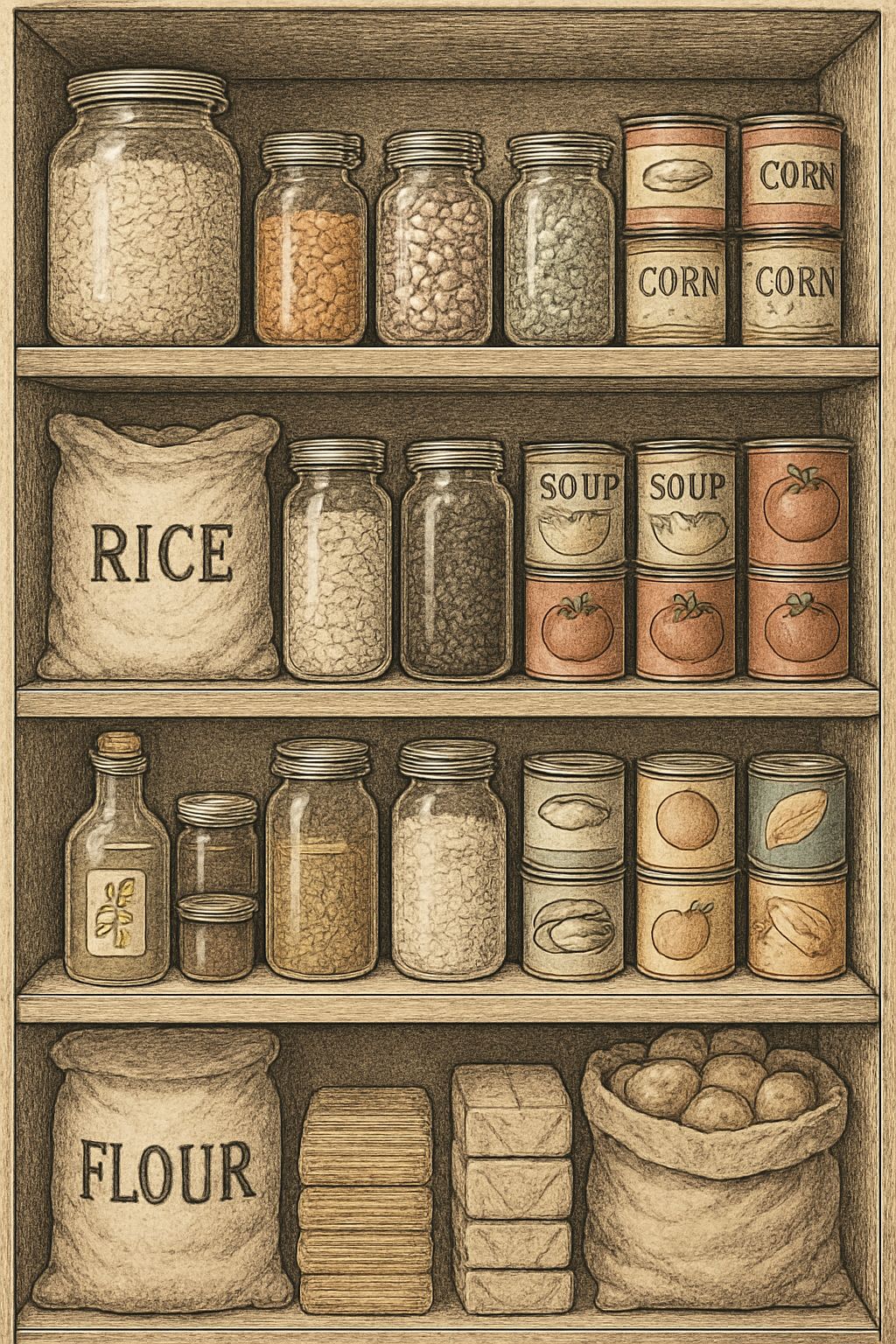
The Foods That Belong in Every Home Storage
Most people don’t think about emergency food storage until they need it — and by then, it’s too late.
Whether it’s a winter storm that locks you in for a week, a job loss that tightens the budget, or a larger-scale disruption to the supply chain, a well-stocked pantry is one of the most practical things a family can have. It’s not about fear — it’s about being ready.
The key is knowing which foods are actually worth storing. Not everything belongs in an emergency pantry. The best foods for emergency storage share three qualities: they have a long shelf life, they provide real nutritional value, and they’re versatile enough to build actual meals around. With those criteria in mind, here’s exactly what you should be stocking — and how to do it right.
1. Legumes: Dried Beans and Lentils
Dried beans and lentils are the unsung heroes of emergency food storage. Calorie-dense, protein-rich, and incredibly shelf-stable, they’re one of the most cost-effective foods you can stockpile — and one of the most nutritious. Avoid preparedness mistakes by ensuring these legumes are part of your pantry essentials.
Shelf Life and Nutritional Value
Dried beans stored properly in airtight containers can last 3 years or more while maintaining most of their nutritional value. However, there’s a catch: after the 3-year mark, beans begin losing nutritional density even if they remain technically edible and safe to cook. Lentils follow a similar timeline. The goal isn’t just to store them — it’s to rotate them regularly so you’re always pulling from a fresh supply.
From a nutrition standpoint, a single cup of cooked black beans delivers roughly 15 grams of protein and 15 grams of fiber. That matters enormously in an emergency scenario where balanced nutrition is harder to maintain.
Best Varieties to Stock
Not all legumes are created equal when it comes to storage and versatility. Here are the top picks:
- Black beans — High protein, fast-cooking relative to other beans, extremely versatile
- Pinto beans — A staple for soups, stews, and refried beans
- Red and green lentils — No soaking required, cook in under 30 minutes
- Chickpeas (garbanzo beans) — Great for soups, stews, or even roasted as a snack
- Split peas — Ideal for hearty soups, require no soaking
How to Store Them Correctly
The enemies of dried beans are moisture, light, heat, and oxygen. Store them in airtight containers — Mylar bags with oxygen absorbers inside food-grade buckets are the gold standard for long-term storage. A sealed 5-gallon bucket of dried beans kept in a cool, dark location like a basement or root cellar will dramatically outlast beans left in their original paper or plastic bags.
Keep storage temperatures consistently below 70°F where possible. Every 10-degree increase in storage temperature roughly cuts shelf life in half — a fact that’s often overlooked when people store food in garages or warm utility rooms.
Storage Tip: Label every container with the date of purchase and the “rotate by” date. Beans stored in Mylar bags with oxygen absorbers in a cool environment: optimal use within 3 years for best nutrition, though they remain edible beyond that.
2. Rice and Whole Grains
Rice is the most widely consumed staple grain on the planet for good reason — it’s calorie-dense, filling, pairs with almost anything, and when stored correctly, it lasts for decades. Alongside legumes, rice forms the caloric foundation of any serious emergency pantry.
White Rice vs. Brown Rice for Long-Term Storage
This is where a lot of well-intentioned preppers go wrong. Brown rice is nutritionally superior — it retains the bran layer and germ, offering more fiber, vitamins, and minerals. But that same bran layer contains natural oils that cause brown rice to go rancid. Brown rice stored in a cool, dry pantry lasts only about 6 months; in the freezer, up to 1 year. Avoid common pitfalls with preparedness mistakes to ensure your food storage lasts.
White rice, on the other hand, can last up to 25–30 years when sealed in Mylar bags with oxygen absorbers and stored in a cool, dark location. For long-term emergency storage, white rice wins decisively on shelf life. A practical approach is to keep brown rice in your regular meal rotation and rely on white rice as your long-term stockpile anchor.
Other Grains Worth Storing
Rice shouldn’t be your only grain. Oats are an excellent addition — rolled oats stored in airtight containers last 2 years in the pantry and significantly longer in sealed Mylar. Hard red or hard white wheat berries (whole, unground grain) can last 25+ years sealed properly, and can be ground fresh into flour when needed. Cornmeal and quinoa round out a diverse grain stockpile, each bringing different nutritional profiles and cooking applications to the table.
3. Canned and Shelf-Stable Meats
Protein is the hardest macronutrient to maintain in an emergency food supply. Fresh meat is off the table, and dried legumes, while helpful, only go so far. Canned and shelf-stable meats solve this problem directly — offering real, complete protein with almost zero preparation required.
The convenience factor is significant. In a true emergency where fuel, water, or cooking equipment may be limited, canned meats can be eaten straight from the can — no cooking required.
Best Canned Meat Options
- Canned tuna and salmon — High protein, omega-3 fatty acids, widely available and affordable
- Canned chicken — Extremely versatile, works in soups, stews, wraps, and salads
- Canned sardines — Calorie-dense, rich in calcium (bones included), long shelf life
- Spam and canned ham — High sodium but high calorie, useful for energy-demanding situations
- Freeze-dried meats — Premium option with shelf lives of 25+ years; ideal for serious long-term storage
How Long Canned Meats Actually Last
Most commercially canned meats are stamped with a “best by” date of 3–5 years, but research from the U.S. Army Natick Laboratories has shown that properly stored canned goods often remain safe and nutritionally viable well beyond their printed dates. The real risk factors are physical damage to the can (dents, rust, swelling) and storage in extreme heat or humidity — not time alone. Store canned meats in a cool, dry location and inspect cans regularly for any signs of damage or bulging.
4. Cooking Oils and Healthy Fats
Fats are calorie-dense — at 9 calories per gram, they deliver more than twice the energy of carbohydrates or protein. In an emergency situation where caloric intake needs to stay high, cooking oils are one of the most efficient ways to add energy to any meal.
Best Oils for Long-Term Storage
Not all oils are equal when it comes to shelf stability. Coconut oil is the clear leader — its high saturated fat content makes it remarkably resistant to oxidation, with an unopened shelf life of 2 years or more at room temperature. Extra virgin olive oil comes in second, lasting 18–24 months unopened when stored away from light and heat. Vegetable oil and canola oil are affordable, widely available options with a shelf life of roughly 1–2 years unopened. For maximum long-term value, prioritize coconut oil and olive oil as your core storage fats.
Ghee (clarified butter) deserves a special mention. Because the milk solids have been removed, ghee is far more shelf-stable than regular butter — commercially packaged ghee can last up to 1 year at room temperature and significantly longer when refrigerated or frozen. It’s a high-calorie, flavorful cooking fat that adds real variety to emergency meal preparation.
How to Prevent Oils From Going Rancid
Rancidity is caused by oxidation — oxygen, light, and heat are the primary triggers. Store all oils in dark glass or opaque containers, away from direct sunlight and heat sources. Never store cooking oils near your stove or on a countertop that gets afternoon sun. Once opened, olive oil should ideally be used within 30–60 days. For longer storage, some preparedness households vacuum-seal bottles of oil or store smaller bottles to minimize the time between opening and use.
5. Salt, Spices, and Flavor Essentials
Salt is arguably the single most important seasoning to stockpile — and not just for flavor. Salt is a preservation agent used for curing meats and fermenting vegetables, making it a genuinely functional survival tool beyond just cooking. Pure iodized table salt stored in an airtight container has an indefinite shelf life. Stock more than you think you need.
Beyond salt, a core spice collection transforms emergency eating from purely functional to actually enjoyable — which matters more than people realize during prolonged stressful situations. Focus on high-utility spices that work across multiple cuisines: garlic powder, onion powder, black pepper, cumin, chili powder, paprika, oregano, and cinnamon. Whole spices (like peppercorns or cumin seeds) last longer than pre-ground versions. Store spices in airtight glass jars, away from heat, and expect a useful shelf life of 2–4 years for ground spices and 4+ years for whole spices.
6. Nuts and Nut Butters
Nuts are one of the most calorie-dense whole foods you can store — a single ounce of almonds packs around 164 calories, 6 grams of protein, and 14 grams of healthy fat. They also require zero preparation and can be eaten straight from storage, which makes them invaluable in a scenario where cooking isn’t possible. Nut butters bring the same caloric density in a more accessible form, especially for families with young children.
The main challenge with nuts and nut butters is their natural oil content, which makes them susceptible to rancidity — the same oxidation problem as cooking oils. This is manageable with the right storage approach, but it does mean nuts require more attention than grains or legumes.
Best Nuts to Store and Why
Almonds are the top pick for long-term storage due to their relatively stable fat profile and impressive nutritional density. Walnuts are highly nutritious but go rancid faster than other nuts due to their high polyunsaturated fat content — they’re better suited for medium-term storage. Peanuts (technically legumes) and peanut butter are the most affordable high-protein, high-fat storage option available. Cashews offer a mild flavor that works well in both sweet and savory applications.
For nut butters, look for natural varieties without added oils or stabilizers — ironically, these store slightly less long than commercial peanut butter because the natural oils can separate and oxidize, but they offer better nutritional quality. Commercial peanut butter in an unopened jar lasts 1–2 years at room temperature and is one of the best calorie-per-dollar storage foods available.
Fridge vs. Freezer: Where Nuts Last Longest
At room temperature in a sealed container, most shelled nuts last 1–6 months in the pantry depending on variety. Move them to the refrigerator and that extends to roughly 1 year. The freezer is the real long-term solution — properly sealed nuts stored in the freezer can last up to 2 years without significant quality loss.
For nut butters, an unopened commercial jar is fine at room temperature. Once opened, natural nut butters benefit from refrigeration to slow oil oxidation. If you’re buying in bulk, freeze extra jars — peanut butter freezes well and thaws without any change in texture or flavor.
7. Baking Staples
The ability to bake from scratch during an extended emergency is a significant capability — it means you can produce bread, flatbreads, pancakes, and simple desserts from shelf-stable ingredients, adding both nutrition and morale to a difficult situation.
Flour, Yeast, Baking Powder, and Baking Soda
Each baking staple has its own storage quirks and shelf life. Here’s a quick breakdown of what to expect:
|
Baking Staple |
Pantry Shelf Life |
Freezer Shelf Life |
Storage Notes |
|---|---|---|---|
|
All-purpose white flour |
1–2 years (sealed) |
Up to 2 years |
Airtight container essential; absorbs odors |
|
Whole wheat flour |
1–3 months |
Up to 6 months |
High oil content; goes rancid quickly at room temp |
|
Active dry yeast |
2–4 years (unopened) |
Indefinite (sealed) |
Store unopened packets in the freezer for best results |
|
Baking powder |
1 year (opened) |
Not recommended |
Test potency by dropping in hot water; should bubble vigorously |
|
Baking soda |
2 years (opened) |
Not recommended |
Absorbs odors; seal tightly after opening |
Baking soda does double duty — it’s both a leavening agent and a legitimate cleaning and deodorizing agent, making it one of the most practical multi-use items in any emergency stockpile. Stock more than you think you need.
Sugar and honey also belong in this category. Granulated white sugar has an indefinite shelf life when kept dry and sealed. Honey is perhaps the most shelf-stable food that exists — archaeologists have found 3,000-year-old honey in Egyptian tombs that was still edible. Both serve as sweeteners, preservatives, and emergency energy sources.
Proper Long-Term Storage for Flour
Flour is trickier to store long-term than most people realize. At room temperature in its original paper bag, all-purpose flour lasts only about 6–8 months before quality begins to decline. The upgrade is simple: transfer flour to airtight food-grade containers immediately after purchase. For extended storage, Mylar bags with oxygen absorbers inside sealed buckets can extend white flour’s shelf life to 5+ years.
One often-overlooked tip: freeze flour for 48 hours before transferring it to long-term storage containers. This kills any insect eggs that may be present in the flour — a common cause of pantry pest infestations that most people don’t discover until it’s too late.
8. Pasta and Broths
Pasta and broths are the workhorses of emergency meal planning — together they form the base of an almost infinite number of quick, filling, comforting meals that can be built from whatever else is in your stockpile. For more tips on being prepared, check out preparedness mistakes most beginners make.
Why Pasta is One of the Best Storage Foods
Dried pasta is one of the most storage-friendly foods available. It’s lightweight, calorie-dense at roughly 200 calories per 2-ounce serving, easy to cook with minimal water and fuel, and — critically — it stores exceptionally well. Commercially dried pasta in its original sealed packaging lasts 1–2 years, but pasta transferred to airtight containers and stored in a cool, dark location can maintain quality for up to 3 years or longer.
Variety matters here for long-term meal planning. Stocking multiple pasta shapes — spaghetti, penne, rotini, egg noodles, and rice noodles for gluten-free options — keeps meals from becoming repetitive. Ramen noodles deserve a spot too: they’re inexpensive, cook in 3 minutes, and while the sodium-heavy flavor packets aren’t nutritional powerhouses, the noodles themselves are a quick calorie source.
Stocks, Broths, and Bouillon: Which to Choose
Canned broths (chicken, beef, vegetable) are excellent for immediate use and have a shelf life of 3–5 years. However, they’re heavy, take up significant storage space, and once opened must be used quickly. Bouillon cubes and powder concentrates are the smarter long-term storage choice — compact, lightweight, and with shelf lives of 2 years or more, they deliver the same flavor base with a fraction of the storage footprint.
Better Than Bouillon concentrated paste is a popular option that delivers deep, restaurant-quality flavor from a single jar — though it requires refrigeration after opening, which is worth factoring into your planning. For purely shelf-stable, no-refrigeration-needed broth flavoring, individual bouillon packets or cubes from brands like Knorr are the most practical choice for a serious emergency pantry.
9. Canned and Dried Fruits and Vegetables
Fruits and vegetables are the most nutritionally important and most commonly neglected category in emergency food storage. When fresh produce is unavailable, canned and dried options become the primary source of vitamins, minerals, and fiber — nutrients that are easy to overlook when you’re focused on calories and protein. Canned vegetables like green beans, corn, diced tomatoes, pumpkin puree, and mixed vegetables have a shelf life of 3–5 years and require zero preparation. Canned fruits packed in juice (rather than syrup) provide a natural sweetness and vitamin C that helps maintain morale and nutrition alike. Freeze-dried fruits and vegetables, while more expensive, offer shelf lives of 25+ years and retain a far higher percentage of their original nutrients compared to standard canning methods — making them a worthwhile investment for a serious long-term emergency pantry.
10. Luxury and Comfort Items Worth Storing
Survival nutrition keeps you alive — comfort food keeps you sane. After several days of eating rice, beans, and canned tuna, morale takes a real hit. Smart emergency planners always include a small category of comfort and luxury items that make difficult situations more bearable, especially for families with children.
Think instant coffee, tea bags, hot cocoa mix, hard candy, chocolate, shelf-stable crackers, and your family’s favorite shelf-stable snacks. These items have genuine psychological value during stressful situations. Instant coffee alone can transform a miserable morning into something manageable. Jerky and dried fruit make excellent snacks that pull double duty as comfort food and genuine nutrition. Even a few packets of your favorite seasoning mix or a bottle of hot sauce can dramatically improve the eating experience when you’re working through a limited pantry for weeks at a time.
How to Organize and Maintain Your Food Storage
Building a stockpile is only half the job. An unorganized, poorly maintained food storage system leads to expired food, wasted money, and a false sense of security. The way you organize and manage your storage is what separates a functional emergency pantry from a cluttered shelf of expired cans.
The Golden Rule of Food Storage: Store what you eat, and eat what you store. A pantry full of foods your family won’t actually prepare or eat in an emergency is not a food storage system — it’s a waste of money waiting to happen. Build your stockpile around meals your household already makes regularly, then expand from there.
Start by doing a complete inventory of what you currently have. Note the purchase dates, “best by” dates, and quantities of everything. This baseline audit is the foundation of a rotation system that actually works — and most people skip it entirely, which is why they end up discovering expired food years later.
Once your inventory is established, organize your storage space so that newer items go to the back and older items stay at the front. This is called FIFO — First In, First Out — and it’s the same system used by grocery stores and commercial kitchens worldwide. Applied consistently, it means you’ll naturally use your oldest stock first without having to think about it.
Short-Term, Medium-Term, and Long-Term Storage Categories
Thinking about your food storage in three distinct tiers makes the whole system more manageable. Short-term storage is your everyday pantry — food you buy, use, and replace on a normal weekly or monthly basis. The goal here is to maintain at least two weeks’ worth of your regular meals at all times. These are the fresh, refrigerated, and frozen items alongside your pantry regulars.
Medium-term storage is your extended buffer — shelf-stable staples like pasta, canned goods, cooking oils, and dried beans with shelf lives of two to five years. Long-term storage is your deep reserve: white rice, wheat berries, honey, salt, freeze-dried foods, and other items with shelf lives measured in decades. These three tiers work together to give your household coverage for anything from a two-week weather event to a prolonged supply chain disruption.
The Right Environment for Dry Food Storage
The ideal storage environment is cool (consistently below 70°F), dark, and dry. Basements and interior closets are excellent. Garages, attics, and areas near appliances that generate heat are poor choices — temperature fluctuations and humidity accelerate the degradation of nearly every food type. Even a 10-degree difference in average storage temperature can cut the shelf life of many foods in half.
Humidity is the other major enemy. Moisture causes clumping in grains and flours, promotes mold growth, and accelerates the rusting of cans. If your storage area tends to be humid, a small dehumidifier or moisture-absorbing products like DampRid can protect your investment. Silica gel packets inside sealed storage containers add an additional layer of moisture protection for items like dried herbs, spices, and baking staples.
How to Rotate Your Stock Without Wasting Food
The most effective rotation system is one that integrates seamlessly into how your family already shops and eats. Set a calendar reminder every 3–6 months to do a quick stockpile check — pull anything approaching its “best by” date into active kitchen use and replace it with fresh stock. Many families find it helpful to keep a simple spreadsheet or even a handwritten log taped inside a pantry door that tracks quantities and dates at a glance. The goal is never to let anything expire unused — if you’re consistently finding expired food, it means you’re storing things your family doesn’t actually eat, and it’s time to reassess what you’re stockpiling.
Dealing With Pests Before They Become a Problem
Pantry pests — specifically Indian meal moths, weevils, and grain beetles — are one of the most common and frustrating problems in food storage. The bad news is that these insects often arrive in food already, as microscopic eggs laid inside grain products before they even reach store shelves. The good news is that prevention is straightforward when you know what to do.
The single most effective prevention measure is freezing all newly purchased grains, flour, rice, oats, and dried legumes for a minimum of 48–72 hours before transferring them to long-term airtight storage containers. This kills any eggs present. Beyond that, store all dry goods in hard-sided airtight containers rather than their original paper or thin plastic packaging — glass jars, food-grade plastic containers with locking lids, and sealed Mylar bags inside buckets all work well. Bay leaves placed inside storage containers and on pantry shelves are a well-known natural deterrent that many experienced preppers swear by, though airtight storage is always your primary defense.
A Well-Stocked Pantry is Your Best Emergency Plan
Emergency preparedness doesn’t require a bunker or a massive budget — it requires intention and consistency. Start with two weeks of short-term food your family already eats. Add a layer of medium-term staples over the following months. Then build toward a longer-term reserve as your space and budget allow. The families who weather emergencies with the least disruption aren’t the ones who panicked and bought everything at once — they’re the ones who built steadily over time.
The foods covered in this guide — legumes, white rice, canned meats, healthy fats, salt and spices, nuts and nut butters, baking staples, pasta, canned produce, and comfort items — form a complete, nutritionally balanced emergency food system that can sustain a family through almost any scenario. Store what you eat, rotate consistently, protect your supply from heat, moisture, and pests, and you’ll have something genuinely valuable: the confidence that your family is covered no matter what happens next.
Frequently Asked Questions
Here are answers to the most common questions people have when building their emergency food storage for the first time.
How much food should I have stored at home at any given time?
The answer depends on your household size, storage space, and how seriously you want to prepare — but here’s a practical tiered framework:
- Minimum baseline: 2 weeks of short-term food your family regularly eats
- Solid preparedness: 3 months of medium-term staples covering full daily caloric needs
- Advanced preparedness: 6 months to 1 year of combined short, medium, and long-term storage
- Full self-sufficiency preparation: 1 year or more, incorporating freeze-dried and sealed long-term foods
The Federal Emergency Management Agency (FEMA) recommends a minimum of 72 hours of emergency food and water supplies per person as an absolute baseline. Most preparedness experts consider this the bare minimum — not a target to aim for.
For a family of four, a three-month supply requires roughly 1,200 to 1,500 calories per person per day across all food categories. That translates to approximately 50 lbs of grains, 25 lbs of legumes, 20 lbs of fats and oils, and supplementary canned proteins and produce to hit complete nutritional coverage — numbers that sound large until you realize how quickly a pantry can be built up with consistent, intentional weekly shopping.
The most important thing is to start. Having one month of food stored is infinitely better than having none. Set a realistic goal based on your current storage space and budget, and build incrementally from there rather than trying to do everything at once. For more tips, consider avoiding preparedness mistakes that most beginners make.
Revisit your storage goals annually. Life circumstances change — family size grows, dietary needs shift, and your storage space may expand or contract. A food storage plan that made sense for a family of three may need adjustment when a fourth family member arrives or when children’s nutritional needs change as they grow.
What is the single most important food to have in long-term storage?
White rice is the single most important food to prioritize for long-term emergency storage. No other commonly available food combines the shelf life (25–30 years when properly sealed), caloric density, cooking versatility, and affordability that white rice offers. A sealed 5-gallon bucket of white rice stored in a cool, dark location represents thousands of calories of emergency nutrition at a very low cost per calorie — making it the foundational food of virtually every serious long-term preparedness plan.
That said, white rice alone is nutritionally incomplete. It provides carbohydrates and modest protein but lacks significant fat content and several key vitamins and minerals. This is why the combination of white rice and dried beans is often called the “perfect emergency food pairing” — together, they provide complete protein (all essential amino acids), substantial calories, and complementary nutritional profiles that neither food achieves alone. If you could only stock two foods for long-term storage, rice and beans would be the answer. For more tips on preparedness, consider cooking without electricity.
How do I store food long-term on a tight budget?
Start with the highest-value, lowest-cost items first: white rice, dried beans, oats, salt, and sugar. These four items can be purchased in bulk at warehouse stores like Costco or Sam’s Club for a fraction of the per-unit cost at regular grocery stores. A 50 lb bag of white rice and a 25 lb bag of dried pinto beans represent a significant caloric reserve for under $50 in most markets. Transfer them into Mylar bags with oxygen absorbers (available cheaply online) inside food-grade buckets, and you have long-term storage that rivals products sold at premium prices by specialty preparedness retailers.
Can I stockpile food in an apartment with limited space?
Absolutely — limited space requires creative thinking, not abandonment of the goal. Under-bed storage with flat rolling containers is one of the most underutilized spaces in any apartment. The backs of closets, the space above kitchen cabinets, and the area beneath bathroom sinks (for non-food items, freeing up kitchen space) are all viable storage locations. Vacuum-sealed bags can dramatically compress the storage footprint of dried goods. Prioritize calorie-dense, compact foods like rice, beans, pasta, nut butters, and canned meats that deliver maximum nutrition per cubic inch of storage space.
In a small apartment, even a single well-organized shelf in a closet can hold a meaningful emergency supply. A standard wire shelving unit (roughly 6 feet tall by 3 feet wide) dedicated to emergency food storage can hold a one-to-two month supply for a single person or a solid two-week supply for a family of four when packed efficiently with the right foods. Start with whatever space you have — even a modest, organized supply is a significant advantage over being completely unprepared.
How do I know when stored food has gone bad?
For canned goods, the warning signs are clear and should never be ignored: bulging or swollen lids, rusted or deeply dented cans (especially dents along the seam), leaking, or any off smell when opened are all indicators that the food should be discarded immediately. Swollen cans in particular are a potential indicator of Clostridium botulinum — the bacterium responsible for botulism — and should be handled carefully and disposed of without opening.
For dry goods like grains, flour, and legumes, the most reliable indicators are smell, appearance, and texture. Rancid flour has a distinctly sour or paint-like smell that’s unmistakable once you know it. Grains infested with pantry pests will show visible insect activity, webbing, or small holes in individual kernels. Any dry goods with visible mold — which typically indicates moisture infiltration — should be discarded entirely.
Cooking oils and nuts go rancid in a predictable way: they develop a sharp, bitter, crayon-like or paint-like odor and taste. Rancid fats won’t necessarily make you immediately sick in small quantities, but they have degraded nutritional value and taste unpleasant — and regular consumption of highly oxidized fats is not advisable. When in doubt, smell it, and trust your nose.
The safest overall approach is proactive rather than reactive: maintain a consistent rotation system so food rarely approaches the outer limits of its shelf life in the first place. Foods regularly rotated into active kitchen use and replaced with fresh stock are almost never a concern. The problem foods are always the ones that got pushed to the back and forgotten — which is exactly why a well-organized, labeled, and regularly audited storage system is worth every bit of the effort it takes to maintain. For more on efficient storage, consider exploring decision-making frameworks for preparedness.
When it comes to being prepared for emergencies, having a well-stocked pantry is crucial. Ensuring that you have essential foods on hand can make a significant difference in how well you can manage unexpected situations. Additionally, understanding why self-sufficiency starts with small daily decisions can help you build a more resilient lifestyle. Items like canned goods, grains, and other non-perishable foods are excellent choices to keep in your storage for long-term use. By planning ahead and making thoughtful choices, you can ensure that your household is ready to face any challenge that comes its way.




Leave a Reply