
Article At A Glance:
- AI is already embedded in your daily life — from your phone’s autocorrect to the Netflix shows recommended to you, you interact with AI dozens of times a day without realizing it.
- Machine learning is the most common form of AI in use today, powering everything from fraud detection at your bank to the voice assistant on your smart speaker.
- Half of teens ages 14–22 have already used generative AI, mostly for getting information and brainstorming — and what they know about using it wisely might surprise you.
- AI literacy is quickly becoming as essential as basic digital literacy — understanding how these tools work helps you use them smarter and safer.
- There’s a right and wrong way to use AI in your everyday life — later in this article, we break down five practical steps to make AI work for you, not against you.
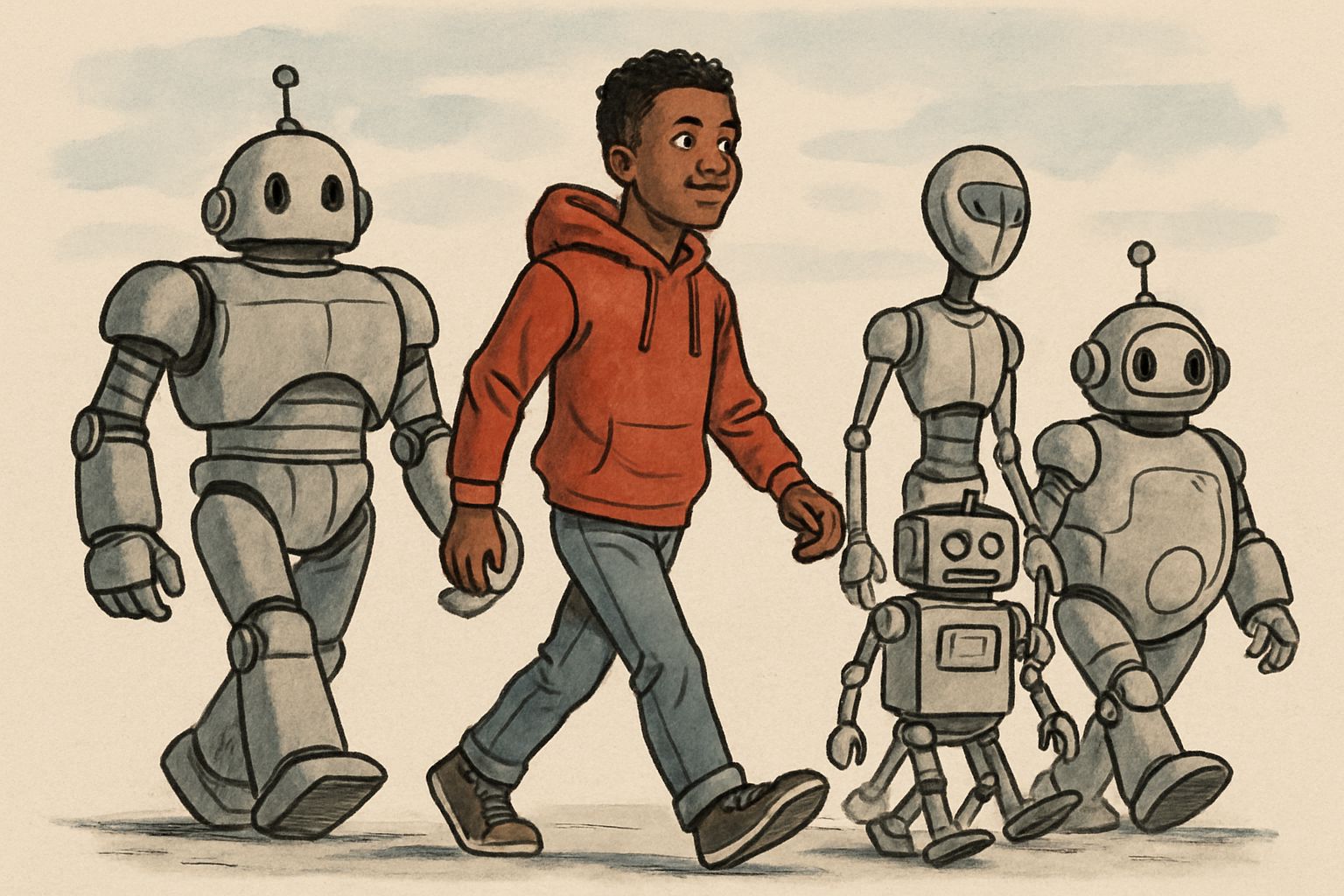
AI isn’t coming — it’s already here, quietly running in the background of almost everything you do online.
Most people picture humanoid robots or science fiction supercomputers when they hear “artificial intelligence.” The reality is far less dramatic but far more interesting. AI is already woven into the apps on your phone, the websites you browse, and the recommendations you get from your favorite streaming service. Understanding what AI actually is — and how it works in everyday settings — puts you in control instead of just along for the ride. Resources like AI awareness tools for everyday users are helping bridge the gap between tech insiders and the rest of us.
AI Is Everywhere — Here’s What You Need to Know
The term “AI” gets thrown around constantly, but it’s often misunderstood. At its core, artificial intelligence refers to computer systems that can perform tasks that normally require human intelligence — things like recognizing speech, identifying patterns, making decisions, and translating languages. It’s a broad umbrella that covers a wide range of technologies, not just one single thing.
What makes this moment different from any other point in tech history is the speed at which AI has entered everyday life. It’s no longer limited to research labs or billion-dollar corporations. It’s in your pocket, your home, your doctor’s office, and your kid’s classroom.
What “AI” Actually Means in Plain Terms
Artificial intelligence is the simulation of human intelligence by machines. That means a computer system is designed to learn, reason, and make decisions — rather than just follow a fixed set of instructions. When your email app filters spam, that’s AI. When Spotify builds you a personalized playlist, that’s AI. When your phone unlocks by recognizing your face, that’s AI too.
Why AI Awareness Matters Right Now
Knowing how AI works isn’t just for developers or data scientists anymore. As AI becomes more deeply embedded in healthcare, finance, education, and media, the ability to understand and evaluate AI-powered tools is becoming a basic life skill. People who understand AI can make better decisions about which tools to trust, how to protect their data, and how to use these technologies to their actual advantage. For example, understanding AI’s role in financial health can lead to more informed budgeting decisions.
Ignoring AI doesn’t make it go away — it just means you’re making decisions without the full picture.
How AI Shows Up in Your Everyday Life
Here’s something worth sitting with: you probably interact with AI-powered technology at least a dozen times before lunch. Most of these interactions are so seamless you wouldn’t even notice them unless someone pointed them out. That’s by design — the best AI is invisible.
AI is active across nearly every digital touchpoint in modern life. The industries it currently impacts most include:
- Healthcare — diagnostic imaging, patient monitoring, wellness apps
- Finance — fraud detection, credit scoring, algorithmic trading
- Transportation — GPS route optimization, ride-sharing logistics, autonomous vehicle research
- Entertainment — content recommendation engines, AI-generated music, streaming platform algorithms
- Education — personalized learning platforms, automated grading tools, student support chatbots
- Retail — inventory forecasting, dynamic pricing, personalized product recommendations
AI in Your Phone and Smart Devices
Your smartphone is one of the most sophisticated AI devices most people will ever own. Face ID, voice recognition, predictive text, real-time photo enhancement, and even battery optimization are all powered by on-device machine learning models. Apple’s Neural Engine and Google’s Tensor chip are purpose-built to run these AI tasks faster and more efficiently than standard processors.
AI Behind Your Social Media Feed
Every time you scroll through Instagram, TikTok, or Facebook, an AI recommendation engine is deciding what you see — and in what order. These systems analyze your past behavior, engagement patterns, and even how long you pause on certain content to predict what will keep you scrolling longest. It’s not random, and it’s not curated by humans. It’s an algorithm optimized for engagement, running continuously in real time.
AI in Shopping, Streaming, and Recommendations
Netflix, Amazon, Spotify, and YouTube all rely heavily on AI-powered recommendation engines. When Netflix suggests a show you end up loving, that’s the result of a collaborative filtering model analyzing the viewing habits of millions of users with similar taste profiles to yours. Amazon’s recommendation engine is estimated to drive a significant portion of its total revenue — a direct example of how AI translates into real-world business results. For more insights on managing digital content, check out these tips to manage fake news.
Even the search bar on a retail website uses natural language processing (NLP) — a branch of AI — to understand what you’re actually looking for, not just match your exact words.
AI in Healthcare and Personal Wellness Apps
AI is making serious inroads in healthcare. From apps that track your heart rate variability and flag irregularities, to clinical tools that assist radiologists in reading medical imaging scans, AI is actively being used to support diagnosis and patient care. Wearables like the Apple Watch Series 9 use AI to detect atrial fibrillation — a potentially life-threatening heart condition — directly from your wrist.
Wellness apps like Calm and Noom also use machine learning to personalize user experiences, adjusting content and coaching based on behavioral data over time.
Machine Learning: The Engine Powering Most AI Today
When people talk about AI in practical settings — not science fiction — they’re almost always talking about machine learning. It’s the most common and most impactful form of AI currently in use, and it’s responsible for most of the AI-powered experiences described above.
How Machine Learning Actually Works
Machine learning is a subset of AI in which a system learns from data rather than being explicitly programmed with rules. Instead of a developer writing out every possible scenario and outcome, a machine learning model is trained on large datasets and learns to identify patterns on its own. The more data it sees, the better it gets at making predictions or decisions.
A spam filter is a classic example. Rather than a programmer manually listing every spam phrase, the model is trained on millions of emails — labeled spam or not spam — and learns to distinguish between them on its own. Over time, as it sees new examples, it continues to improve. For more insights into AI applications, you can explore what artificial intelligence is and how it impacts various fields.
This learning-from-data approach is what makes modern AI so flexible and powerful across so many different applications.
The Difference Between AI, Machine Learning, and Deep Learning
These three terms get used interchangeably, but they’re not the same thing. Think of them as nested layers. AI is the broadest category — any system that mimics human intelligence. Machine learning is a specific approach to building AI, where systems learn from data. Deep learning goes even further, using layered neural networks inspired by the human brain to process complex inputs like images, audio, and natural language. Most of the AI you interact with daily — voice assistants, image recognition, recommendation engines — runs on deep learning models.
How Teens Are Already Using AI — And What Adults Can Learn From Them
There’s a generational divide forming around AI, and it’s not going in the direction most adults expect. While many parents and teachers are still debating whether AI is a problem to be managed, teenagers are already deep in it — using it casually, creatively, and often more thoughtfully than the adults around them realize. For those looking to bridge this gap, understanding how to manage misinformation can be a good starting point.
The conversation about AI in schools has largely been framed around cheating and academic dishonesty. But that framing misses the bigger picture entirely. Teens are using AI to brainstorm ideas, process difficult emotions, get answers to questions they’re too embarrassed to ask a person, and explore creative projects. The tool itself isn’t the issue — it’s the lack of guidance around how to use it well.
- Half of young people ages 14–22 have used generative AI at some point
- Only 4% identify as daily users — far fewer than media coverage might suggest
- The most common uses are getting information (53%) and brainstorming (51%)
- Many teens use AI to get answers to sensitive questions they wouldn’t ask adults directly
- Students are concerned about AI being weaponized for bullying and disinformation
Understanding how teens actually use AI — rather than how adults assume they use it — opens up a much more productive conversation about responsible use, critical thinking, and digital literacy.
What Harvard Research Found About Teen AI Use
A report examining how young people engage with generative AI revealed that teen usage is both more nuanced and more widespread than most adults assume. Researchers found that students who used AI for brainstorming and information gathering were “significantly more likely” to engage with the technology in varied and exploratory ways. The data showed that generative AI is functioning, for many teens, as a first stop for answers — a role previously held by search engines, and before that, asking a trusted adult.
What Teens Want Parents and Teachers to Know
When asked what they wished adults understood about their AI use, teens consistently highlighted three things: that AI helps with creative work, not just shortcut-taking; that they bring real personal questions to these tools; and that they share genuine concerns about AI being misused for harassment and the spread of false information. These aren’t passive consumers — they’re actively thinking about the implications of the technology they’re using daily.
The Gap Between How Adults and Kids See AI
The disconnect between how adults perceive teen AI use and how teens actually experience it creates a real problem. When adults default to suspicion, they shut down the opportunity to guide young people toward smarter, more ethical AI habits. The better move is to stay curious and stay in the conversation.
How Teens vs. Adults Tend to View Everyday AI Use
Perspective
Common Adult View
Common Teen View
Primary concern
Cheating and academic dishonesty
Misuse for bullying and disinformation
Main use case
Assumed to be shortcuts
Information gathering and brainstorming
Emotional role
Not considered
Safe space for sensitive questions
Frequency of use
Assumed to be constant
Only 4% are daily users
Attitude toward AI
Cautious or resistant
Pragmatic and exploratory
The gap isn’t just about technology — it’s about trust and communication. Teens who feel judged for using AI stop talking about it, which means they also stop getting guidance about using it responsibly.
Closing this gap starts with adults getting more AI-literate themselves. You can’t have a meaningful conversation about a tool you’ve never tried, much like you can’t effectively navigate without basic navigation skills.
Chatbots and AI Assistants: What They Can and Cannot Do
Generative AI tools like ChatGPT, Google Gemini, and Microsoft Copilot have shifted from novelty to utility remarkably fast. These tools can write, summarize, translate, brainstorm, explain complex topics, and assist with coding — all in real time, conversationally. That’s genuinely powerful. But knowing where they fall short is just as important as knowing what they’re good at.
Chatbots are language models, not knowledge databases. They generate responses based on patterns learned during training, which means they can sound confident while being wrong. This distinction matters enormously for how you should — and shouldn’t — rely on them.
Where Chatbots Excel in Real-Time Support
AI assistants have carved out a real and legitimate role in everyday productivity. Used correctly, they can dramatically reduce the time you spend on routine tasks and help you think through problems more clearly. For those interested in enhancing their skills, basic navigation skills can also complement your efficiency.
The strongest use cases for chatbots and AI assistants right now include:
- Drafting and editing text — emails, reports, social media captions, cover letters
- Brainstorming and ideation — generating ideas, exploring angles, breaking through creative blocks
- Summarizing long content — condensing articles, documents, or meeting notes into key points
- Explaining complex topics — breaking down technical or academic subjects in plain language
- Customer support — handling frequently asked questions and routing inquiries 24/7
- Language translation — real-time translation across dozens of languages
- Coding assistance — writing, debugging, and explaining code for developers and beginners alike
These aren’t marginal use cases — they represent real time savings and real capability gains for everyday users who know how to prompt these tools effectively.
The Limits You Should Always Keep in Mind
The biggest risk with AI chatbots isn’t malicious intent — it’s overconfidence. These systems are designed to produce fluent, coherent-sounding responses, which means errors can be hard to spot if you’re not already familiar with the topic.
AI language models have a training data cutoff, which means they don’t have access to real-time information unless specifically connected to a live search tool. Asking ChatGPT about yesterday’s news without a browsing plugin will get you an outdated or fabricated answer.
They also “hallucinate” — a term used when an AI generates information that sounds plausible but is factually incorrect. This happens most often with specific facts, statistics, citations, and names. Always verify before you act on anything an AI tells you.
- No real-time knowledge without a live search connection
- Prone to hallucination — especially with numbers, dates, and citations
- No genuine understanding — outputs are pattern-based, not reasoned
- Privacy risks — sensitive inputs may be stored or used for model training
- Bias in outputs — models reflect the biases present in their training data
How to Use AI Smarter in Your Own Life
Knowing AI exists and understanding how to use it well are two completely different things. These five steps will help you move from passive AI user to intentional one — getting real value from these tools while avoiding the common traps, such as managing fake news.
1. Learn to Spot AI-Powered Tools Around You
Start by simply noticing AI in action. The next time you get a product recommendation, see a personalized ad, use autocomplete in a search bar, or hear a virtual assistant respond — recognize that as AI. Building this awareness is the first step toward understanding the technology on your own terms, rather than just being subject to it without realizing it.
2. Use AI to Save Time on Repetitive Tasks
AI tools like Microsoft Copilot, integrated directly into Microsoft 365, can draft emails, summarize documents, and generate slide content automatically. Google’s Gemini does the same within Google Workspace. If you’re spending significant time on tasks that involve writing, formatting, scheduling, or data organization, there’s likely an AI tool that can cut that time dramatically — often by half or more. For those interested in optimizing their workflow, exploring essentialism in financial health can provide additional insights.
3. Verify AI-Generated Information Before You Trust It
This one cannot be overstated. AI language models generate responses based on statistical patterns, not factual lookup. That means they can produce text that reads as authoritative while being partially or entirely wrong. The technical term for this is hallucination, and it happens most frequently with specific statistics, citations, names, and recent events.
The fix is straightforward: treat AI output the way you’d treat information from a well-read friend who sometimes misremembers details. It’s a useful starting point, not a final source. Cross-reference anything important with a credible primary source before you repeat it, publish it, or act on it.
4. Protect Your Personal Data When Using AI Apps
Many AI tools are free to use because your inputs — your prompts, questions, and conversations — may be used to improve the model. Before you share anything sensitive with an AI tool, check the privacy policy. Avoid entering personal identifying information, financial details, health data, or confidential business information into any AI system you haven’t vetted. Tools like ChatGPT offer options to disable chat history, which prevents your conversations from being used for model training — a simple setting worth turning on if privacy matters to you.
5. Stay Curious — AI Literacy Is the New Digital Literacy
A decade ago, knowing how to use a smartphone effectively gave you a real advantage. Today, that advantage belongs to people who understand AI. You don’t need to become a developer or study machine learning — but staying curious, experimenting with tools, and keeping up with how AI is evolving in your industry will put you well ahead of the curve. Platforms like Coursera, Khan Academy, and Google’s AI literacy programs offer free beginner-friendly resources that make it easy to build foundational knowledge at your own pace.
AI Awareness Is No Longer Optional
The shift has already happened. AI isn’t a future technology you can afford to think about later — it’s a present reality shaping what information you see, what opportunities you’re offered, and how the tools you use every day make decisions about you. The people who will navigate this era most successfully are those who understand enough to engage with AI critically rather than just accept it passively.
AI literacy doesn’t require a technical background. It requires curiosity, a willingness to experiment, and the habit of asking questions about the tools you use. The five steps outlined above are a practical place to start — and each one builds on the last.
Quick Reference: AI Awareness Checklist for Everyday Users
Action
Why It Matters
Difficulty Level
Spot AI-powered tools in daily life
Builds baseline awareness and critical thinking
Easy
Use AI for repetitive tasks
Saves time and increases personal productivity
Easy to Moderate
Verify AI-generated information
Prevents spreading misinformation or making bad decisions
Easy
Review privacy settings on AI apps
Protects sensitive personal and professional data
Easy to Moderate
Complete an AI literacy course
Builds foundational knowledge for long-term advantage
Moderate
Start with one item on this list. Just one. Awareness compounds — the more you notice and engage, the faster your understanding grows. You don’t have to master AI overnight, but you do have to start.
Frequently Asked Questions
These are the questions most people have when they start paying closer attention to AI in everyday life — answered directly, without the jargon.
What Is the Most Common Form of AI Used Today?
Machine learning is the most common form of artificial intelligence in use today. It powers the recommendation engines on streaming platforms, the fraud detection systems at your bank, the spam filters in your email, and the voice recognition in your smart speaker. Rather than following fixed rules written by a programmer, machine learning models learn patterns from large datasets and use those patterns to make predictions or decisions.
Deep learning — a more advanced subset of machine learning that uses layered neural networks — is what drives more complex applications like image recognition, natural language processing, and generative AI tools like ChatGPT and Google Gemini. When most people talk about “AI” in a consumer technology context today, they’re referring to systems built on machine learning or deep learning foundations.
Is AI Safe to Use in Everyday Life?
For most everyday applications — productivity tools, recommendation engines, navigation apps, voice assistants — AI is safe and genuinely useful. The risks are less about dramatic scenarios and more about subtler concerns: data privacy, the spread of misinformation from unchecked AI outputs, algorithmic bias, and over-reliance on AI for decisions that require human judgment. Used with awareness and a critical eye, AI tools offer significant benefits with manageable risks.
How Is AI Different From a Regular Computer Program?
Feature
Traditional Computer Program
AI-Powered System
How it works
Follows explicit rules written by a programmer
Learns patterns from data
Adaptability
Fixed — only does what it’s programmed to do
Improves with more data and experience
Handling new situations
Fails or returns an error
Makes a best prediction based on learned patterns
Example
A calculator
A spam filter that gets smarter over time
Decision-making
Deterministic — same input always gives same output
Probabilistic — outputs can vary based on context
A traditional computer program is like a very precise recipe — it does exactly what the instructions say, every time, without variation. An AI system is more like an experienced chef who has cooked thousands of meals and can improvise intelligently when an ingredient is missing.
This distinction matters for everyday users because it changes how you should interact with these tools. A calculator will always give you the same answer to the same problem. An AI assistant might give you a slightly different response depending on how you phrase your question — and occasionally get it wrong in ways a calculator never would.
Understanding this helps set the right expectations and makes you a smarter, more effective user of AI tools from the start.
Can AI Make Mistakes?
Common Types of AI Errors and What Causes Them
Error Type
What It Looks Like
Common Cause
Hallucination
Confidently stating incorrect facts
Pattern-based generation without true comprehension
Bias
Skewed outputs that favor certain groups
Imbalanced or unrepresentative training data
Outdated information
Citing old statistics or missing recent events
Training data cutoff date
Misinterpretation
Answering a different question than what was asked
Ambiguous prompts or language nuance gaps
Overconfidence
Presenting uncertain information without caveats
Optimization for fluency over accuracy
Yes — AI makes mistakes, and it does so in ways that are distinctly different from human error. While a person might say “I’m not sure about that,” an AI system can produce a confidently worded, grammatically perfect response that is factually wrong. This is one of the most important things everyday users need to understand about the technology.
The most well-documented failure mode is hallucination. AI language models like GPT-4 and Google Gemini have been documented producing fabricated citations, inventing quotes from real people, and generating plausible-sounding statistics that don’t exist. This doesn’t make them useless — it makes them tools that require human oversight.
The practical takeaway is simple: never use AI output as your sole source for anything consequential. Use it as a starting point, a sounding board, or a draft — then verify independently before you rely on what it tells you.
How Can I Improve My AI Literacy as a Beginner?
Start by using the tools. You will learn more from thirty minutes of hands-on experimentation with ChatGPT, Google Gemini, or Microsoft Copilot than from reading about them for hours. Try asking the same question multiple ways and observe how the outputs change. Notice where the responses are strong and where they feel vague or questionable. That hands-on instinct is the foundation of real AI literacy.
From there, structured learning helps fill in the gaps. Google offers a free AI Literacy program through its Applied Digital Skills platform. Coursera hosts beginner courses from institutions like DeepLearning.AI and IBM that require zero prior technical knowledge. MIT OpenCourseWare has free materials on AI fundamentals for those who want to go deeper into the mechanics.
Follow the conversation. Subscribing to newsletters like The Rundown AI or MIT Technology Review’s The Algorithm keeps you updated on how AI is developing in real time — in plain language, without requiring a computer science degree. Staying informed is itself a form of AI literacy, because the landscape changes fast and what’s true about AI today may shift significantly within a year.
Most importantly, don’t wait until you feel “ready.” AI literacy is built through consistent, curious engagement — not through achieving some threshold of expertise before you start. Pick one tool, try one task, and build from there. The gap between those who understand AI and those who don’t is widening quickly, and the best time to start closing it is right now.




Leave a Reply