
- Exercise balls force your core to stabilize constantly — unlike floor exercises, every movement on an unstable surface activates deep stabilizer muscles that standard crunches simply miss.
- Anti-extension and anti-rotation training are the two most important core functions you’re probably neglecting — and the exercise ball targets both directly.
- John Shackleton, M.S., C.S.C.S., founder of Shack Fit, built a specific stability ball core circuit designed to transfer directly to real-world movement and athletic performance.
- Your core is the link between your upper and lower body — strengthening it on an unstable surface improves balance, posture, and injury prevention simultaneously.
- There’s a specific circuit structure and weekly frequency that maximizes results — and most people are doing it completely wrong.
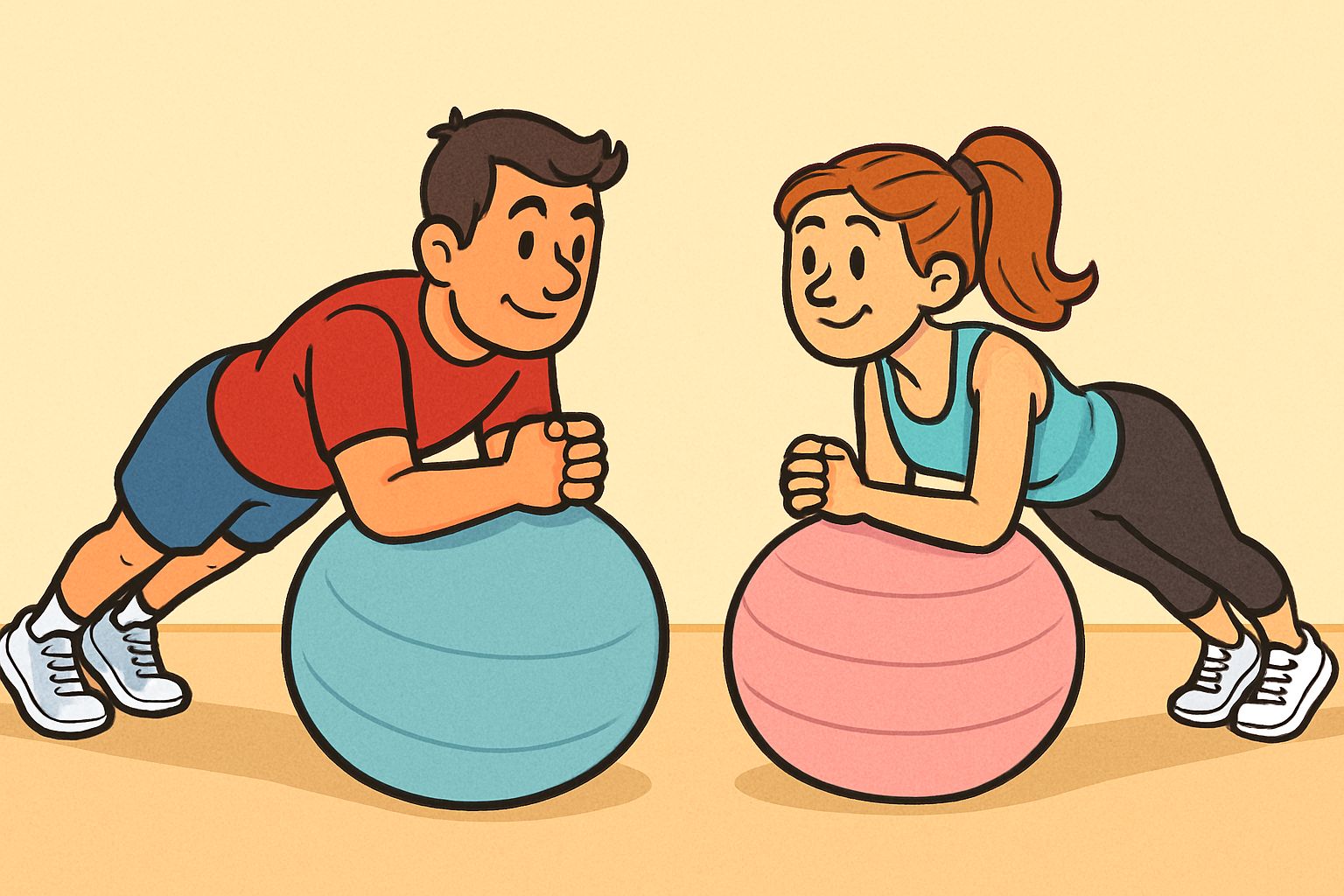
Most people think they have a decent core — until they step onto an unstable surface and everything falls apart.
The exercise ball has been sitting in gym corners and garage piles for decades, dismissed as a prop for aerobics classes or physical therapy. That’s a serious mistake. When used correctly, it’s one of the most powerful tools for building functional core strength that actually transfers to how you move in real life. For fitness enthusiasts looking to dig deeper into evidence-based training methods, resources that bridge expert knowledge with practical application make all the difference in building a training program that works.
Your Core Is Weaker Than You Think — Here’s What to Do About It
Your core isn’t just your abs. It’s a complex system of muscles — including the transverse abdominis, multifidus, internal and external obliques, and the muscles of your hips and lower back — that work together to stabilize your spine and transfer force between your upper and lower body. Think of it as the central link in a chain. When that link is weak, everything suffers: your lifts stall, your posture breaks down, and your injury risk climbs.
The problem with most core training is that it’s too isolated. Floor crunches and sit-ups train your rectus abdominis in a controlled, predictable environment. Real movement isn’t predictable. Your core needs to stabilize while your limbs are moving, while your balance is being challenged, and while force is being transferred in multiple directions at once. That’s exactly what the exercise ball trains.
Why an Exercise Ball Beats a Mat for Core Training
Floor exercises have their place, but they remove one critical variable: instability. The moment you place your body on an exercise ball, your nervous system goes on high alert. Every micro-movement requires a response. Your deep stabilizer muscles — the ones that protect your spine and power your movement — fire continuously just to keep you balanced.
Unstable Surfaces Force Constant Muscle Activation
When you perform a plank on the floor, your body finds a stable groove quickly. The same plank on an exercise ball never fully stabilizes. Your core has to make constant micro-adjustments, which means more total muscle activation across the entire trunk. Research consistently shows that unstable surface training increases activation of the deep stabilizing muscles compared to the same exercises performed on a stable surface.
Anti-Extension and Anti-Rotation Demand More From Your Trunk
According to John Shackleton, M.S., C.S.C.S., founder of Shack Fit, “The stability ball increases the demand on anti-extension and anti-rotation, but the real benefit is in the dynamic stability challenge.” Anti-extension means resisting the force that tries to arch your lower back. Anti-rotation means resisting the force that tries to twist your spine. Both are critical for real-world and athletic performance — and both are heavily loaded during exercise ball training. For more on combining physical techniques with mental preparedness, check out this guide on physical and psychological preparedness.
Brain-Body Communication Gets a Serious Upgrade
Exercising on an unstable surface forces continuous communication between your brain and body through proprioceptors — sensory receptors in your muscles and joints that detect position and movement. Over time, this improves your neuromuscular coordination, which means your body gets better at activating the right muscles at the right time. That translates directly to better performance in sports, better movement in daily life, and a significantly reduced risk of injury.
How to Choose the Right Size Exercise Ball
Before you start any of these techniques, you need to be on the correct size ball. Using the wrong size throws off your body positioning and reduces the effectiveness of every exercise.
|
Your Height |
Ball Diameter |
|---|---|
|
Under 5’0″ |
45 cm |
|
5’0″ – 5’5″ |
55 cm |
|
5’6″ – 6’0″ |
65 cm |
|
Over 6’0″ |
75 cm |
The simple test: sit on the ball with your feet flat on the floor. Your hips and knees should both be at roughly 90-degree angles. If your hips are lower than your knees, size up. If you’re sitting too high, size down.
Core Stabilization Techniques on the Exercise Ball
These aren’t random exercises thrown together. Each technique below targets a specific function of core stability — from anti-extension to rotational control to full posterior chain integration. Master these and you’ll build a core that performs as well as it looks.
Plate Reach: Build Anti-Extension Strength
The plate reach is a foundational anti-extension drill. Start in a kneeling plank with your forearms resting on the exercise ball, forming a straight line from your head to your knees. Engage your abs, then move your forearms in a slow counter-clockwise circle, allowing the ball to move with them. The goal is to resist any arching through your lower back as your arms reach away from your center of gravity. That resistance is your anti-extension system working. Perform 10 to 15 reps per direction. For additional insights on maintaining readiness, explore the psychology of effective injury recovery.
Plate Rotation: Train Your Obliques and Transverse Plane Control
Plate rotations on the exercise ball are one of the most underused oblique exercises in existence. Lie supine on the ball with your upper back supported, feet flat on the floor, and hips lifted into a bridge position. Hold a weight plate with both arms extended over your chest. From there, slowly rotate the plate toward one side, keeping your arms straight and your hips level throughout the movement. The rotation happens at your trunk — not your hips — which is exactly what trains transverse plane control.
This movement strengthens the obliques while simultaneously challenging your ability to resist unwanted rotation — a quality that directly improves athletic performance and protects your lumbar spine during heavy compound lifts. Start light. Even a 10-pound plate will expose weaknesses in your rotational stability you didn’t know existed. For those recovering from injuries, understanding the psychology of effective injury recovery can be beneficial.
Plank With Leg Lift: Activate the Posterior Chain
Set up in a forearm plank with both forearms resting on the exercise ball. Your body should form a straight line from head to heels. From this position, slowly lift one leg a few inches off the ground without allowing your hips to rotate or your lower back to arch. Hold for one to two seconds, then lower and switch sides. For a comprehensive approach to fitness, consider combining physical and psychological preparedness with relaxation and breathing techniques.
What makes this variation so effective is the combination of demands it places on your system simultaneously. Your anterior core is fighting anti-extension from the ball. Your posterior chain — glutes, hamstrings, and spinal erectors — is activating to lift and stabilize the leg. And your lateral stabilizers are working overtime to prevent your hips from dropping to one side. Ten to fifteen reps per leg is the target, but quality of movement matters far more than rep count here.
Dynamic Copenhagen Plank: Challenge Hip and Core Integration
The Copenhagen plank is already one of the most demanding hip adductor and core exercises available. Adding the exercise ball underneath elevates it further. Set up in a side plank position with your top foot resting on the ball and your bottom leg either floating or lightly touching the ground. The goal is to maintain a rigid lateral line from your shoulder to your foot while the ball constantly challenges your balance. This exercise exposes weaknesses in hip-core integration that standard planks never reach — and building strength here has a direct carryover to single-leg athletic movements, running mechanics, and injury prevention in the groin and hip complex.
The Stability Ball Core Circuit That Actually Works
John Shackleton’s stability ball core circuit was designed with one principle in mind: the trunk must stabilize while the limbs are moving. That’s the real-world demand. That’s what makes this circuit different from a random collection of ab exercises.
The circuit strings all four techniques together in sequence with minimal rest between exercises. This approach keeps the core under sustained tension, elevates your heart rate, and challenges your neuromuscular system to maintain stability under fatigue — which is exactly the condition your core needs to perform in during sports and daily life.
The exercises flow in an intentional order: anti-extension first to prime the deep stabilizers, then rotational work to load the obliques, then the plank variations to integrate the whole system. Don’t shuffle the order. The sequencing matters.
How Many Reps and Sets to Do
Perform 10 to 15 reps per exercise, moving continuously from one to the next with minimal rest between movements. Once you’ve completed all four exercises, that’s one round. Rest for 60 seconds, then repeat. Aim for 2 to 3 rounds total per session. The entire circuit takes between 15 and 30 minutes depending on your rest intervals and rep pace.
How to Use It as a Warm-Up or Accessory Work
As a Warm-Up: Run 1 round of the circuit before your main lifts. Focus on controlled movement and breathing. This primes your deep stabilizers, activates your posterior chain, and gets your nervous system dialed in before you load the bar.
As Accessory Work: Run 2–3 rounds after your primary strength work. Use this as a finisher to build core endurance and reinforce movement patterns under fatigue.
As a Standalone Session: On active recovery days or when you’re short on time, the full 3-round circuit on its own is a complete, low-impact core training session.
If you’re incorporating this circuit as a warm-up, keep the weight plate light — the goal is activation, not max effort. Save the heavier plate rotations for when you’re using the circuit as standalone accessory work.
One thing most people get wrong is rushing through the reps. Speed kills the stimulus here. Every repetition should be slow and deliberate, with a full pause at the end range of each movement. Your deep stabilizers respond to time under tension, not velocity.
You can incorporate this stability ball core circuit into your routine up to three times per week. Give yourself at least one rest day between sessions to allow your stabilizer muscles — which fatigue differently than prime movers — to recover fully before the next training bout.
The Real Benefits Beyond Six-Pack Abs
Training your core on an exercise ball builds something far more valuable than visible abs. It builds a body that works — one that can absorb force, transfer power, maintain posture under load, and move without breaking down. The visual benefits are a byproduct of functional training done right.
A strong core underpins nearly every physical task you perform, from carrying groceries to hitting a tennis ball to picking up your kids. According to Harvard Health, core muscles are the sturdy central link in the chain connecting your upper and lower body — and when that link is weak, everything from your athletic performance to your daily comfort suffers.
Better Balance Reduces Your Risk of Falling
Your core is your body’s primary balance system. It stabilizes your spine and pelvis during every movement, allowing you to shift, pivot, and react without losing control. When your core stabilizers are trained on an unstable surface like an exercise ball, that balance capacity improves significantly — and the benefits extend well beyond the gym.
For older adults especially, core training on an unstable surface has meaningful implications for fall prevention. But even for younger, athletic populations, the improved proprioception and reactive stability that comes from consistent exercise ball training reduces the risk of ankle sprains, knee injuries, and lower back problems during high-demand activities.
Stronger Posture Protects Your Spine Long-Term
Most posture problems trace back to weak stabilizers, not tight muscles. When the deep muscles surrounding your spine — particularly the multifidus and transverse abdominis — aren’t doing their job, your body compensates by over-recruiting the wrong muscles. That leads to the forward head posture, rounded shoulders, and anterior pelvic tilt that plague desk workers and athletes alike. Exercise ball training directly targets these deep stabilizers in a way that seated posture correction exercises simply cannot replicate.
Over time, consistent exercise ball core training re-educates your body’s default position. Your spine learns to find neutral under load. Your pelvis stops tilting. Your shoulders stop rounding forward. These aren’t cosmetic changes — they’re structural adaptations that reduce chronic pain, improve breathing mechanics, and protect your discs and vertebrae from the cumulative stress of poor alignment over years and decades.
Add the Exercise Ball to Your Weekly Routine — Here’s How Often
Three sessions per week is the sweet spot for exercise ball core training. This frequency gives you enough volume to drive adaptation while allowing adequate recovery between sessions. You can pair it with upper body days, lower body days, or use it as a standalone active recovery session. The key is consistency over intensity — showing up three times per week with controlled, deliberate technique will outperform one brutal session followed by days of avoidance. If you’re a beginner, start with one to two sessions per week, master the movement patterns, then build up to three as your stability improves.
Frequently Asked Questions
Here are the most common questions people have about exercise ball core techniques, answered directly and without the fluff.
What muscles does an exercise ball target during core stabilization?
Exercise ball core training targets the transverse abdominis, multifidus, internal and external obliques, rectus abdominis, spinal erectors, glutes, and hip flexors — simultaneously. Unlike floor exercises that isolate one muscle group at a time, the unstable surface of the exercise ball forces all of these muscles to co-contract and communicate in real time. The deep stabilizers — particularly the transverse abdominis and multifidus — get the most unique benefit, since they’re rarely loaded effectively by traditional ab exercises.
Can beginners use an exercise ball for core training?
Yes — but progression matters. Beginners should start with the most stable positions first, such as seated balance on the ball or a supported supine bridge, before moving into plank variations and leg lifts. The goal in the early stages is learning how to find and maintain a neutral spine on the ball, not loading up with weight plates or chasing rep counts. For more information on effective exercises, check out these stability ball exercises.
Give yourself two to four weeks of foundational work before attempting the full circuit. During that period, focus on body awareness, breathing, and bracing technique. Once you can hold a stable forearm plank on the ball for 30 seconds without your hips dropping or rotating, you’re ready to progress to the complete technique sequence.
How does an exercise ball improve posture?
An exercise ball improves posture by strengthening the deep spinal stabilizers that hold your vertebrae in proper alignment. When the multifidus and transverse abdominis are strong and responsive, your spine naturally returns to a neutral position under load and at rest. The exercise ball accelerates this process because it removes the stable surface your body normally relies on — forcing your postural muscles to stay engaged throughout every movement rather than shutting off when you find a comfortable position.
Some people also use an exercise ball as a replacement for their desk chair during work hours. While the research on this is mixed, the principle is sound: removing back support forces your postural muscles to maintain your position actively rather than leaning on external support. Even 20 to 30 minutes of seated work on an exercise ball can build low-level postural endurance over time.
Is an exercise ball better than a plank on the floor for core stability?
For training dynamic stability and deep stabilizer activation, yes — the exercise ball plank outperforms the floor plank. The unstable surface prevents your body from finding a locked-in groove, which means your core has to work continuously rather than settling into a static hold. That said, the two variations aren’t competing — they’re complementary. Floor planks build raw isometric endurance and max tension. Exercise ball planks build dynamic stability and neuromuscular coordination. A complete core training program includes both.
How long does it take to see results from exercise ball core training?
Weeks 1–2: Improved body awareness and proprioception. You’ll notice better balance and a stronger mind-muscle connection during core movements.
Weeks 3–4: Noticeable improvement in stability during compound lifts. Your plank endurance increases. Lower back fatigue during workouts begins to decrease.
Weeks 5–8: Visible improvement in posture. Stronger transfer to athletic movements. Deep stabilizer muscles begin to respond reflexively rather than requiring conscious activation.
Week 8+: Measurable strength gains in rotational and anti-extension control. Reduced lower back discomfort. Improved performance across all movement patterns.
Most people feel the difference in their balance and movement quality within the first two weeks — that’s the nervous system adapting. Structural strength changes take longer, typically four to eight weeks of consistent training before they become measurable in your lifts and daily movement.
The most important variable isn’t how long you train — it’s how consistently you train. Three sessions per week of deliberate, technically sound exercise ball core work will produce results faster than sporadic high-volume sessions with poor form. Track your progress by noting how long you can maintain a stable plank on the ball and how controlled your plate rotations feel at a given weight.
The exercise ball is not a gimmick. It’s a precision training tool that, when used with the right techniques, builds a core that performs under pressure, protects your spine over the long term, and transfers directly to everything from heavy deadlifts to weekend hiking trails. The techniques outlined here — anti-extension, anti-rotation, posterior chain integration, and dynamic hip-core coordination — cover every dimension of functional core stability. Put them together in Shackleton’s circuit, train three times a week, and you’ll build a core that most people never develop simply because they never stepped off the mat.
If you’re ready to take your core training seriously and want expert-backed guidance to build a body that’s strong, stable, and resilient, explore the training resources available to support your fitness journey from the ground up.




Leave a Reply